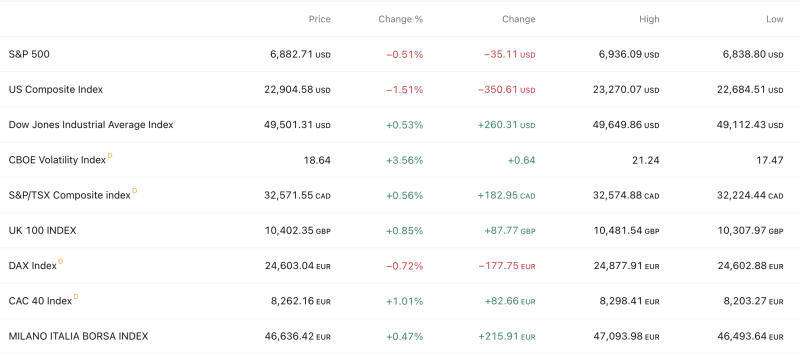
Wall Street closed on a mixed note on February 4, 2026, with the S&P 500 falling 0.51% to 6,882.71 and the US Composite (Nasdaq) sliding 1.51% to 22,904.58, weighed down by technology heavyweights. In contrast, the Dow Jones Industrial Average gained 260.31 points (+0.53%) to 49,501.31, signaling rotation into industrial and defensive names. The CBOE Volatility Index (VIX) jumped 3.56% to 18.64, reflecting rising market uncertainty.
Across global markets, sentiment remained mixed. UK’s FTSE 100 rose 0.85%, CAC 40 gained 1.01%, while Germany’s DAX declined 0.72%, highlighting uneven risk appetite across regions.
Big Tech and ETFs Drive Dollar Volume; NVDA and TSLA Lead Declines
In dollar-volume leaders, SPY fell 0.49% to $686.10 and QQQ dropped 1.75% to $605.75, mirroring broader market weakness. NVIDIA (NVDA) declined 3.41% to $174.19, and Tesla (TSLA) dropped 3.78% to $406.01, emerging as key drags on growth indices. Meanwhile, Apple (AAPL) bucked the trend, rising 2.60% to $276.49, providing partial support to mega-cap sentiment.
High Retail Activity in Leveraged and Small-Cap Names
By share volume, SOXS topped activity with over 1.06 billion shares traded, followed by BYAH (559 million) and MOBX (417 million), indicating elevated speculative and hedging flows. NVIDIA also saw heavy trading with over 202 million shares, underscoring strong institutional positioning amid volatility.
Extreme Movers Signal Speculative Froth and Risk
On the momentum side, EXEEW surged an extraordinary +1,237,523%, while OBAI (+167%) and ENPX (+77%) posted outsized gains, pointing to speculative trading in micro-cap and derivative-linked counters. On the downside, AHMA plunged 76.6%, QETAR dropped 75%, and EZRAW fell 63%, highlighting sharp risk-off in weaker balance-sheet names.
Volatility Rising as Market Rotation Intensifies
With VIX near 19 and Nasdaq under pressure, traders are closely watching sector rotation, bond yields, and macro signals for directional cues. Strength in industrials versus weakness in growth suggests positioning shifts rather than broad liquidation, keeping markets in a consolidation phase.