Mr. Bhupinder Singh, Founder, InCred Group-
"This Budget has many positive structural elements and reflects a long term growth mindset. The strong push on infrastructure, domestic manufacturing and the technology ecosystem can meaningfully strengthen India's industrial and innovation base. At the same time, the sharp increase in STT on futures and options has understandably unsettled markets and could weigh on trading volumes at a delicate moment. Predictability and active participation are vital for deep capital markets, so ongoing engagement between government and market stakeholders will be key."
Mr. Paul Salnikoff, Managing Director and CEO, Executive Centre India Limited.
"The Union Budget underscores the government's continued focus on strengthening urban infrastructure and improving capital access for long-term commercial development. Over the past decade, instruments such as REITs and InvITs have enhanced transparency and institutional participation in India's real estate ecosystem. The proposed infrastructure risk guarantee fund and calibrated partial credit guarantees further reinforce lender confidence by addressing construction-phase risks. For enterprise-focused workspace providers operating in India's leading business districts, these measures support the creation of high-quality, professionally managed office environments aligned with evolving occupier expectations. The parallel emphasis on strengthening hospitality and service-led institutions also contributes to building a skilled, customer-centric workforce, supporting sustainable growth across office and workspace platforms."
Post Budget quote of Mr. Madhu Rajputra Peravalli, Co-founder, Troogue-
"Budget 2026 introduces a few important clarifications that are relevant for companies operating at the intersection of AI, digital services, and workforce platforms. The explicit treatment of manpower services under contractor TDS removes an area of ambiguity that enterprises and talent platforms have navigated for years.
The continued emphasis on AI as core digital infrastructure, along with references to ethical AI, skills mapping, and responsible technology adoption, reflects the direction in which the ecosystem is moving.
At Troogue.ai, we have been building with this exact reality in mind, enabling enterprises to access domain expertise on demand through a compliant, structured, and evaluation-driven platform. These developments create a more enabling environment for models like ours to operate with greater clarity and confidence."
"India's MSMEs continue to be one of the strongest engines of economic momentum, driving entrepreneurship and employment. The Budget's push to create MSME 'future champions' with its ₹10,000 crore MSME Growth Fund and the ₹2,000 crore top-up to the Self-Reliant India Fund is a welcome step, particularly because it directly addresses three long-standing growth bottlenecks: access to equity capital, predictable liquidity, and faster payment cycles through structural reforms such as TReDS and GeM integration.
Equally important is the continued emphasis on digital infrastructure and simplifying business processes. As MSMEs increasingly rely on digital platforms to improve discovery, expand reach and boost productivity, these efforts create a stronger foundation for MSMEs to scale with confidence and consistency." -Mr. Shwetank Dixit, Chief Growth Officer, JustDial.
"The budget proposal unveiling a Rs.10,000 crore Biopharma Shakti initiative will strengthen India's position as a global biopharma hub. It is encouraging to note that this initiative will boost research and innovation in the biotechnology and pharma sectors. The plan to establish 3 new All India Institutes of Ayurveda will go a long way in giving an impetus to the fortunes of the ayurvedic sector in the country. The finance minister's move to provide customs duty exemption on 17 medicines and also adding 7 rare diseases for relief is an exceptional move that will support a large number of citizens, especially those suffering from cancer." Shreevalli V, COO - Kinder Women's Hospital And Fertility Centre, Bangalore.
Mohal Lalbhai, Founder & Group CEO on behalf of Matter Motor -India's first geared electric bike manufacturer.
"The Union Budget 2026 reinforces the Government's long-term focus on strengthening India's advanced manufacturing ecosystem, even as direct EV-specific incentives remain measured. The emphasis on strategic manufacturing, India Semiconductor Mission 2.0, and high-precision engineering underlines a clear shift towards capability-led growth over short-term subsidies.
For electric mobility, this is critical. Future competitiveness will be driven by power electronics, battery management systems, motor technologies, intelligent vehicle platforms, innovation in alternate materials, and Advanced Integrated Drivetrain Vehicles (AIDV). The Budget's focus on critical minerals, rare earth processing, and component ecosystems supports resilient, India-based supply chains for next-generation EV powertrains.
At MATTER, built on deep in-house engineering and integrated manufacturing, this policy direction aligns strongly with our approach, enabling Indian EV companies to compete globally on performance, innovation, and export readiness in line with the Innovate in India, Make in India, Make for the World vision."
Mr. Shubham Jain, Group CEO, Infomerics Valuation and Rating Ltd-
"A meaningful step towards deepening India's corporate and municipal bond markets by proposing a market-making framework, introducing new derivative instruments, and strengthening incentives for large municipal bond issuances while continuing support under the AMRUT scheme. These measures are expected to improve secondary market liquidity, broaden investor participation, and enhance price discovery, particularly for long-tenor and sub-sovereign issuances. Importantly, the Government's continued emphasis on fiscal prudence and calibrated borrowing is reassuring for debt markets, as it helps contain crowding-out risks and anchors investor confidence. Together, these initiatives should encourage greater bond market participation by India Inc. and urban local bodies, while reinforcing the role of bonds as a sustainable and diversified funding avenue."
Mr Manoj Bhat, Managing Director & CEO of Mahindra Holidays & Resorts India Ltd
"The Union Budget 2026 reinforces the government's intent to use tourism and hospitality as levers for balanced economic growth rather than treating them as standalone consumption sectors. The focus on destination development beyond metros, improved physical connectivity, and a sharper push on spiritual and heritage circuits reflects a recognition that tourism growth must be geographically distributed and locally rooted.
Equally important is the emphasis on skilling and workforce development. As the sector expands into tier two and three markets, the availability of trained talent will determine not just service quality but the sustainability of growth itself. By linking infrastructure creation with human capital development, the Budget moves the conversation from short-term demand creation to building a resilient, employment-generating tourism ecosystem."
Mr. Bharat Dhawan, Managing Partner, Forvis Mazars in India-“The Union Budget 2026-27 reflects a clear commitment to the people of India by turning vision into action. While it acknowledges the structural reforms undertaken to date, it also lays a decisive roadmap for future governance. Through over 350 targeted reforms and a focus on the use of cutting-edge technology, the country is making governance more responsive and manufacturing more self-reliant. Moving beyond paperwork to implement reforms like GST and Labour Code simplifications will directly benefit both the workforce and business owners.
Through this Budget, by investing in sectoral development and empowering areas such as biopharmaceuticals, MSMEs, agriculture, logistics, semiconductors and electronics, the government is laying the foundation for a resilient and competitive Aatmanirbhar Bharat. Expanding the developmental focus to tier 2 and 3 cities ensures that high-quality infrastructure and economic opportunities are no longer confined to major metros but are accessible across all regions. Furthermore, the integration of AI within sectors like banking and education reaffirms a commitment to a forward-looking agenda that scales impact nationwide.
By establishing the High-Level Committee on Banking for Viksit Bharat and creating specialised industrial corridors (rare earth, chemicals), the government is safeguarding the economy against global volatility and strengthening domestic supply chains. This strategy, paired with a focus on high-value agriculture, moves beyond traditional administration to deliver governance that is both resilient and deeply attuned to domestic growth.”
Mr. Madhav Sheth, CEO Ai+ Smartphones and Founder of NxtQuantum Shift Technologies-
"Budget 2026–27 is a decisive signal that India is now playing for depth, not just scale, in electronics—doubling the push on ECMS, expanding electronics PLI to ₹40,000 crore, and rolling out Semiconductor Mission 2.0 across equipment, materials, supply chains and Indian IP. This is how we move from being an assembly base to building a resilient, high-value, India-led ecosystem—de-risking investments in components like display assemblies, camera modules and advanced PCBA, strengthening capital-goods capability through high-tech tool rooms, and cutting import dependence while boosting export competitiveness. For Ai+ Smartphone and NxtQuantum, it creates the runway to deliver on our core belief—'Made in India' must mean 'Designed in India'—by building software-first, India-governed products and a trusted device ecosystem anchored in Indian-owned IP and stronger local manufacturing depth."
“The Budget’s focus on attracting global cloud and data centre investment is a strong signal of India’s intent to become a serious digital infrastructure hub. Tax incentives for companies serving global customers from India, along with safe-harbour provisions, create the right conditions for building scalable, enterprise-grade data platforms.
At the same time, the emphasis on emerging technologies such as AI and continued investment through missions like IndiaAI mission, National Quantum mission, and the Anusandhan National Research Fund highlights that infrastructure alone is not enough as data volumes and AI use scale. The real opportunity lies in how organisations govern, integrate, and use trusted, high-quality data at scale. As more global workloads move to India, strong data management and governance frameworks will be critical to ensuring AI delivers trusted outcomes across sectors from public services to financial markets, including India’s digital public infrastructure and enterprises.”— Varun Babbar, VP and India MD, Qlik
Union budget 2026-27 quote by Mr. Mahesh Kudav, Chairman and Managing Director, Venus Safety and Health Pvt. Ltd. -
Venus Safety welcomes the Union Budget 2026–27, which strengthens India's manufacturing and MSME sector. The proposed ₹10,000 crore SME Growth Fund and the additional ₹4,000 crore boost to the Self-Reliant India Fund will provide critical support to small manufacturers and emerging enterprises.
The Budget's emphasis on linking education, skill development and entrepreneurship with employment is particularly encouraging. Structured skilling initiatives, along with efforts to upgrade traditional knowledge systems, will not only support job creation but also improve productivity and help MSMEs scale in a sustainable manner. This focus on skills becomes especially relevant for labour-intensive manufacturing segments.
In this context, the integrated textile programme announced in the Budget is a timely intervention. Initiatives such as mega textile parks, a strong push on value addition and technical textiles, modernisation of traditional clusters, common testing and certification facilities, and the Samarth 2.0 skilling ecosystem are expected to enhance competitiveness across the textile value chain while opening avenues for innovation and application-driven growth.
Mr. Abhinav Parashar, Co-Founder and CEO at Digio.
"The Union Budget 2026–27 places strong emphasis on technology-led governance, AI adoption, and the expansion of digital infrastructure. As India accelerates its transition towards paperless systems and trusted digital frameworks, the need for secure, scalable, and compliant digital process will become even more critical. The Budget's focus on ease of doing business and automated, rule-based processes align with the growing demand for digital identity, consent, and verification solutions. Altogether, the budget creates a strong foundation for enterprises to adopt end-to-end digital workflows with confidence, reinforcing our role in enabling seamless, secure, and auditable compliant digital transactions across sectors."
It is a positive step that the Union Budget has enhanced the safe harbour threshold for IT services to Rs 2,000 crore from Rs 300 crore. Bringing all IT companies under a single, uniform safe harbour category will simplify compliance, reduce uncertainty, and make tax obligations far more predictable. This change benefits not just small and mid-sized companies, but larger firms as well, lowering the risk of litigation and enabling them to expand globally with confidence. The allocation of Rs 10,000 crore as a growth fund for startups and MSMEs is equally encouraging, as it provides the capital and support needed to scale their operations, innovate, and contribute to India's growing digital economy. Measures like these reinforce India as a stable and attractive base for technology-driven businesses while fostering entrepreneurship and long-term growth.-- said Mr. Satya Yeruva, Co-Founder & CEO of FinStackk.
“The Union Budget meaningfully advances the vision of Viksit Bharat by strengthening India's electronics and semiconductor manufacturing backbone. The ₹40,000 crore allocation for electronics components and semiconductors will directly benefit Aimtron by improving domestic availability of semiconductor-linked components, reducing import dependence, and enabling faster scale-up of our EMS, PCB assembly, box-build, and system integration operations serving India, the US, and global customers. Coupled with the SME Growth Fund and logistics-led infrastructure investments, the budget reinforces India's role as a trusted, export-ready manufacturing hub, aligning closely with Aimtron's India–US growth strategy.”-Mukesh Vasani, Chairman & Managing Director, Aimtron Electronics.
“This is a landmark Budget anchored in the spirit of Kartavya and focused on building economic resilience. The proposal to create Rare Earth Corridors is the missing link for India's EV sovereignty, directly addressing long standing dependence on imported NdFeB magnets. By de risking the value chain from mining to advanced manufacturing and backing strategic and frontier sectors, Budget 2026 lays the foundation for true Atmanirbharta in electric mobility.”- Mr. Jaideep Wadhwa, Director, Sterling Tools Limited
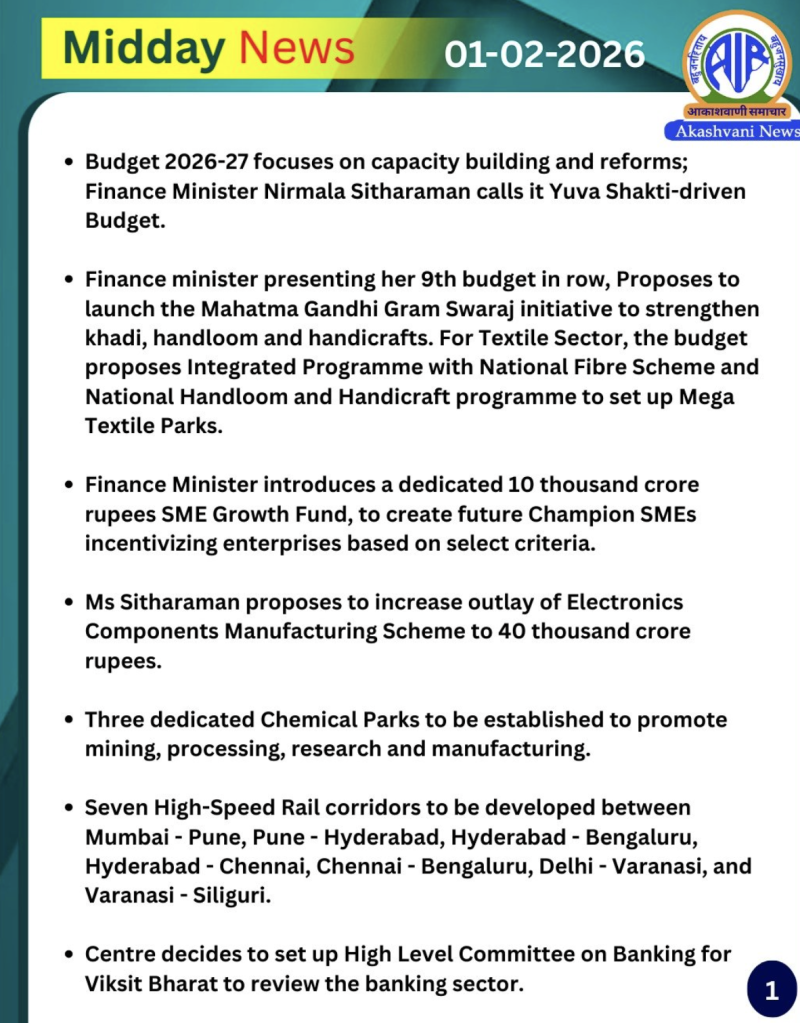
The Union Budget 2026 reinforces India's manufacturing ambitions with an enhanced ₹40,000 crore outlay for electronics manufacturing and a ₹10,000 crore SME Growth Fund to strengthen domestic value chains. These measures will support innovation and scale across the sector, creating a more robust ecosystem in which companies like Calcom Vision can contribute to technology-driven growth and energy-efficient solutions, furthering India's journey as a globally competitive manufacturing hub.— Mr. Abhishek Malik, Executive Director, Calcom Vision Limited
" Aligned with the vision of Viksit Bharat, the Union Budget reinforces the focus on sustainability-driven growth for India's core manufacturing sectors. For stainless steel manufacturers, decarbonisation is pivotal to long-term competitiveness and aligning with global export standards.
The ₹20,000 crore commitment towards carbon capture and utilisation acknowledges the challenges faced by hard-to-abate sectors and is expected to accelerate the adoption of cleaner, more efficient processes across the steel value chain. A well-defined implementation roadmap and access to advanced technologies will be crucial in translating this support into tangible, industry-wide impact. "- Chandragupt Prakash Mangal, Managing Director, Mangalam Worldwide Limited.
Sunil Jhunjhunwala, Co-founder & Managing Director, Technosport on Budget push for MMF, tech upgradation and MSMEs
“We’ve been saying for years that India’s textile competitiveness begins with the basics, consistent raw materials and manufacturing that can scale with global demand. Today’s Budget hits both those notes clearly. Initiatives like the National Fibre Mission will strengthen supply chain security by improving raw material self-reliance, which directly boosts manufacturing competitiveness.
At the same time, the incentives to drive big investments in man-made fibres are exactly the kind of fuel the industry needs to build capability in performance and technical textiles. For brands like Technosport, which are grounded in performance fibres and engineered applications, this improves both scale and export readiness.
On the manufacturing side, exemption of customs duty on shuttle-less looms will accelerate technology upgradation, while Samarth 2.0 can be a real enabler for MSMEs to adopt Industry 4.0 standards without heavy capex. Taken together, these measures strengthen supply-chain security, accelerate technology adoption, and create a more enabling environment for Indian textile manufacturers to scale sustainably and compete globally."
The Honourable Finance Minister Smt. Nirmala Sitharaman has presented a growth-oriented budget delivering a powerful push to infrastructure, manufacturing, and technology, boosting job creation. The vertical transportation industry would benefit from the acceleration of the momentum of construction and real estate growth.
Development of city economic regions, establishment of seven high-speed rail corridors, new schemes for construction and infrastructure equipment manufacturing, proposal of infrastructural risk guarantee fund, massive outlay for semiconductor, rare earth and electronics industries transformation are commendable. At Otis, we welcome the Budget's forward-looking vision and remain committed to supporting India's infrastructure ambitions. Through continuous innovation and digital integration, we are proud to help move people and the nation forward- safely and swiftly."-by Mr. Sebi Joseph, President, Otis India.
Mrs. Anika Parashar, Healthcare Veteran & Social Entrepreneur
"Recognising the link between women's economic empowerment and broader social outcomes. Initiatives like SHE Marts and the She‑Mark badge go beyond credit support - they provide women entrepreneurs with permanent market access, a recognised identity, and structured support to tap into formal financing channels and innovative financial instruments.
For women, this financial independence directly translates into better health and well-being. When women move from credit dependence to enterprise ownership, they gain decision-making power not only in business, but also in health, nutrition, and maternity choices. Financial stability allows women to invest in preventive healthcare for themselves and their families, reduce risks associated with high-risk pregnancies, and ensure timely medical consultations. By linking economic empowerment with health outcomes, these measures position women as leaders in both family and community health, aligned with national priorities of inclusive growth and women-first development."
"Real estate remains central to India's Viksit Bharat vision, supporting employment generation, housing growth, and urban development. The Union Budget 2026 provides a decisive boost to the sector through its emphasis on infrastructure development in Tier 2 and Tier 3 cities, CPSE asset monetisation via REITs, and the introduction of the Infrastructure Risk Guarantee Fund, expected to be around ₹25,000 crore. By de-risking the construction phase, this initiative is likely to enhance private developer confidence. While a stronger push for affordable housing would have been encouraging, the budget outlines a clear path for sustainable urban expansion and reinforces long-term investor confidence and sentiment in the real estate sector." said Mr. Vikas Chaturvedi, Co-Founder & CEO, Xanadu Realty.
Ishita Bansal, Co-founder and COO, Plannex Recycling-
"The women specific announcements in Budget 2026-27 reflect a comprehensive approach to strengthening both women entrepreneurship and workforce participation. This can help women led self help enterprises transition from informal selling to organised retail, improving visibility, pricing power, and income stability. Complementing this, the 58 percent rise in female apprentices between 2021 and 2024 highlights growing momentum, while the ₹10,000 crore District Hostel scheme provides the infrastructure needed to bring more women into the workforce pipeline. By easing housing constraints for female learners, the Budget can unlock participation from the 42 percent of undergraduate women currently outside the labour market. Together, these measures strengthen the education to employment continuum, energise local economies, and build sustainable women led business ecosystems across India."