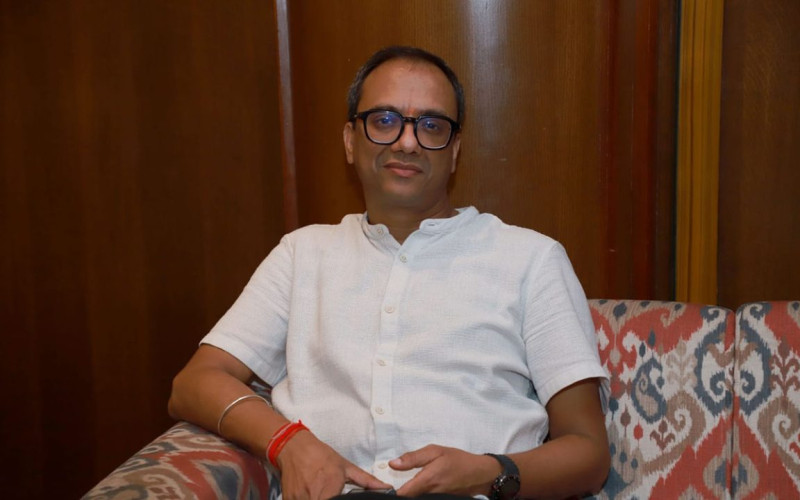
In conversation with Editor Ankur Sharma, The News Strike, Ashish Goyal, a Chartered Accountant with over two decades of corporate experience, explains that his shift toward storytelling was not abrupt but rooted in years of observing human decision-making, responsibility, and ethical dilemmas in professional life. He highlights that while philosophical traditions offer deep insights into these questions, modern content ecosystems often prioritise speed over depth, creating a disconnect between wisdom and accessibility. Through his Guardians of Dharma series, Goyal aims to bridge this gap by moving away from prescriptive lessons and instead creating immersive narratives that allow readers to question, reflect, and derive their own understanding. According to him, storytelling today is not just a creative exercise but a meaningful way to make timeless wisdom relevant in a fast-paced, distraction-driven world.
You’ve had a long corporate career. What led you to move toward storytelling?
It wasn’t a sudden shift. Writing was always there, but quietly.
In my corporate life, I dealt with decisions, consequences, and responsibility every day. Over time, I realised that these are not just business concerns. They are human concerns. The same questions exist in our philosophical traditions.
The real turning point came through conversations at home. When children ask simple but honest questions about right and wrong, you realise that answers cannot remain theoretical. They need to be lived. Storytelling felt like the most natural way to explore that.
What gap did you see in the current content space?
I felt there was a disconnect. On one side, we have rich philosophical traditions. On the other, we have fast-paced content designed for quick consumption. Somewhere in between, depth gets lost.
I did not want to simplify wisdom into lessons. I wanted to create stories where readers can experience it. Where they can question, reflect, and arrive at their own understanding. That space felt missing.
How do you see storytelling evolving in today’s digital world?
Storytelling is not going away. It is only changing form.The real challenge today is attention. We are surrounded by constant input. In such a space, stories that demand patience may seem difficult at first. But I believe they are more necessary now.
A meaningful story slows you down. It asks you to observe. It stays with you. In contrast, a lot of digital content is consumed quickly and forgotten just as quickly.
So, the role of storytelling is becoming more important, not less.
Your work is often described as blending culture with modern themes. How do you approach that balance?
For me, it begins with respect for both. I do not see tradition and modern life as opposing forces. The core ideas in our philosophical texts are still relevant. The challenge is expression.
I try to translate, not retell. The essence remains the same, but the context is contemporary. Characters face situations that today’s readers understand. Through that, the ideas become accessible without feeling imposed.
Would you describe your work as social impact driven?
In a quiet way, yes. I am not trying to create awareness campaigns. But I do believe that stories shape thinking. They influence how we respond to situations, how we make choices, how we understand responsibility.
If a reader pauses and reflects after reading, if they begin to think more carefully about their actions, that is impact.
What are the biggest challenges in this journey?
One challenge is expectation. There is a tendency to look for clear answers. But I do not write to provide answers. I write to explore questions. That can feel unfamiliar to some readers.
Another challenge is the pace of the current content ecosystem. Depth takes time, both to create and to absorb. Staying committed to that approach requires patience.
How can storytelling influence leadership and decision-making?
Leadership is often seen as authority. I see it as responsibility. Stories allow us to examine decisions without real-world risk. We see characters make choices, face consequences, and grow. That process builds awareness.
In many ways, storytelling prepares us for real life situations. It sharpens judgement without being prescriptive.
What trends do you see shaping the future of content in India?
I think there will be a stronger return to rooted narratives. As audiences become more exposed globally, there is also a search for identity. People want stories that reflect their own context, not just borrowed frameworks.
At the same time, the format will continue to evolve. Digital platforms, audio, visual storytelling, all will play a role. The opportunity lies in combining reach with depth.
What is your long-term vision for your work?
I see Guardians of Dharma as more than a book series. It is a starting point.
The larger idea is to build a space where storytelling can engage with philosophy, psychology, and everyday life in a meaningful way. Not as instruction, but as exploration.
If the work encourages even a small shift towards more thoughtful living, I think it is moving in the right direction.