

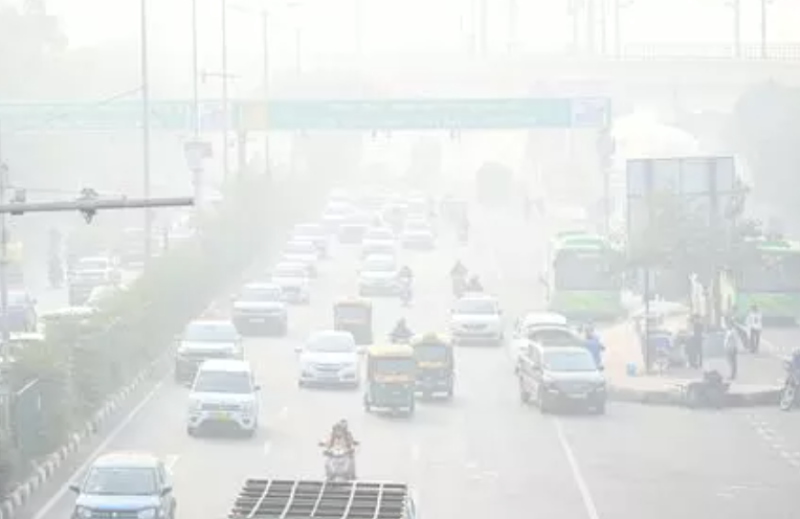
Air pollution in the national capital has escalated to critical levels, with Delhi waking up to a thick blanket of smog on Thursday morning. Visibility was sharply reduced across several areas as hazardous air enveloped the city. In many locations, the Air Quality Index (AQI) crossed the 400 mark, placing air quality firmly in the ‘Severe’ category.
According to data from the Central Pollution Control Board (CPCB), Anand Vihar recorded an AQI of around 415, indicating extremely unhealthy conditions. Similar levels of toxic smog were observed across large parts of the city, raising serious health concerns for residents.
Visuals from RK Puram reflected comparable conditions, where the AQI stood at 374, classified as ‘Very Poor’. In response to the worsening situation, the Commission for Air Quality Management (CAQM) has enforced all measures under GRAP (Graded Response Action Plan) Stage IV across the Delhi-NCR region.
Areas around India Gate were also shrouded in dense smog during the early hours, with an AQI of approximately 344, falling in the ‘Very Poor’ range. Akshardham reported even more alarming figures, with AQI touching 416, categorised as ‘Severe’. Other hotspots included Anand Vihar (416), Vivek Vihar (412), ITO (397), Dwarka (361), Chandni Chowk (387), and the India Gate vicinity (344).
As Delhi continues to struggle under toxic air, authorities have intensified pollution control measures. From today, only BS-VI compliant vehicles are permitted to enter the city. Additionally, restrictions have been tightened at fuel stations, where petrol and diesel are not being dispensed to vehicles lacking a valid Pollution Under Control (PUC) certificate. This has led to long queues at PUC testing centres and petrol pumps since Wednesday morning.

