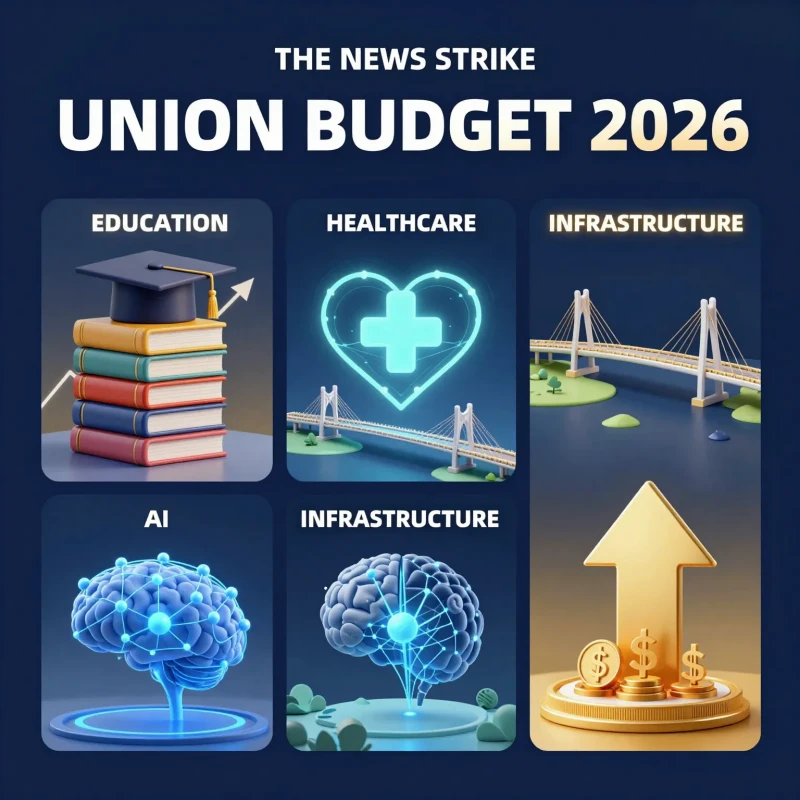
"As India charts its path toward a Viksit Bharat, the Union Budget 2026 presents a pivotal moment to accelerate the nation's human-capital transformation. We expect targeted investments in digital learning infrastructure, inclusive broadband access, and next-generation EdTech platforms to ensure that quality education reaches every learner, whether in metros or rural districts. There should be strong support for skilling and upskilling initiatives aligned with industry needs, particularly in emerging fields like AI, data science, and advanced digital technologies. Strategic budgetary measures that reduce barriers for lifelong learning and foster an industry-ready workforce will be key to bridging the gap between education and employability. By prioritising digital empowerment and skill development, the Budget can unlock equitable opportunities and position India's youth for success in the global knowledge economy."-Anant Bengani, Co - Founder & Director - Zell Education.
Dr. Malini Saba, businesswoman, psychologist, and founder of Saba Group and Saba Family Foundation, says: The upcoming Union Budget 2026–27 comes at a crucial time for India's healthcare system. "Last year, the government made a strong statement by allocating ₹98,311 crore to the Ministry of Health and Family Welfare. When you include AYUSH and health research, the total spends went over ₹1,03,280 crore. These funds have already made a real difference-strengthening the National Health Mission, expanding Ayushman Bharat, and modernizing hospitals across the country."
She highlights some important steps that have already been taken:
- Broader coverage: Ayushman Bharat benefits now include gig and platform workers.
- Affordable care: Customs duty exemptions were introduced on 36 essential life-saving medicines.
-Building capacity: 10,000 new medical seats have been added to strengthen the healthcare workforce.
Looking ahead, Dr. Saba believes the next budget is a chance to take things further. "Investing in AI diagnostics, telemedicine, and digital health platforms can really close the healthcare gap in Tier-2 and Tier-3 cities. At the same time, focusing on mental health and preventive care will help us build a healthcare system that is not just modern, but fair, efficient, and ready for the future. This is the kind of foundation that supports real, inclusive growth for the country.''
By- Chirag Taneja, Co-Founder & CEO, GoKwik
As we approach Union Budget 2026, the sentiment in the D2C ecosystem is one of optimism, driven by the government's decisive pro-growth reforms. The Export Promotion Mission, approved in November 2025 with an outlay of ₹25,060 Cr, is a landmark step that acknowledges the global potential of our MSMEs. Furthermore, the recent GST rationalization on consumer essentials was a masterstroke; our data shows it has directly translated into higher disposable income and visibly uplifted purchasing power in Tier 2 and 3 cities.
To sustain this momentum, the next logical step is to address the inverted duty structure. While the lower output GST on retail goods is excellent for consumers, brands still pay 18% on critical inputs like logistics and digital services. This locks up working capital in Input Tax Credit (ITC). A streamlined refund mechanism would release these funds back into business growth.
Additionally, while the DPDP Act has rightly strengthened consumer trust, the government's ease of doing business approach, specifically exemptions for startups, is commendable. We now hope to see the operationalization of E-commerce Export Hubs with a Green Channel for international returns. This would ensure that the "Make in India" dream is not just manufactured here, but delivered efficiently to the world.
Quote from Avanish Agarwal, Founder, Nutriiya
“As country’s startup ecosystem crosses 1 lakh recognised startups, we look at Union Budget 2026–27 as a crucial opportunity to strengthen AI-led health-tech solutions. With nation’s digital health market projected to cross USD 70 billion in the upcoming years, targeted incentives for AI adoption, R&D, and data infrastructure can assist startups scale impact while enhancing Digital India and the foresight of a healthier Viksit Bharat 2047. Encouraging policies, digital infrastructure and funding can aids startups supports AI for customise nutrition and preventive care driving inclusive growth.”
Nandagopal P, CEO, Asymmetri; CTO, Gacsym Ventures and Limited Partner, Arya Ventures
India is approaching Budget 2026 at a stage where its vast digital scale must now evolve into true global digital leadership. Over the last decade, we've built remarkable digital public infrastructure, but global competitiveness will be decided by depth of compute, AI capability, R&D, cybersecurity, and talent. This Budget is a defining moment to move from a 'Digital Economy 1.0' driven by access and scale, to a 'Digital Economy 2.0' driven by innovation, deep tech, and sovereign digital capacity.
The approval of the ₹1 lakh crore RDI Scheme is a bold and timely step, but capital alone will not create global technology leaders. Budget 2026 must provide the policy backbone, stronger R&D tax incentives, clear IP commercialisation pathways, and support for deep-tech venture funding, so that innovation can move faster from lab to market. For founders and technology leaders, what matters most is an environment where building world-class products in AI, quantum technologies, data, cloud, and frontier tech is globally competitive.
If Budget 2026 gets this right, India can shift from being a large digital market to becoming a true digital superpower, exporting not just services and platforms, but breakthrough technologies that shape the global economy.
Raj Kumar Medimi, Executive Director, Trinity Cleantech
"As India accelerates its journey toward becoming a $5 trillion economy, the upcoming Union Budget presents a critical opportunity to strengthen the country's power and energy infrastructure at the grassroots level. We expect the Budget to place sharper emphasis on transmission and distribution (T&D) upgrades, reduction of technical losses, and large-scale modernization of transformers and substations, which form the backbone of reliable power delivery.
For domestic manufacturers, policy continuity through schemes like PLI, coupled with stricter quality benchmarks and stronger enforcement against sub-standard imports, will be key to creating a level playing field. Incentivizing high-efficiency, low-loss transformers and supporting indigenously manufactured electrical equipment can significantly reduce long-term system costs for DISCOMs.
Additionally, improved access to working capital for MSMEs, faster tendering cycles, and timely payments will go a long way in strengthening India's electrical manufacturing ecosystem. A Budget that balances infrastructure expansion with quality, efficiency, and domestic manufacturing will not only support energy security but also enable sustainable and inclusive growth."
Chanakya Bellam, Director AION-tech instead of Board Member, AION-Tech Solutions Ltd-
As India prepares its Union Budget for 2026–27, AION-Tech Solutions urges policymakers to place future-ready technologies at the center of national economic planning. Strategic investments in artificial intelligence, machine learning, full-stack digital platforms, business intelligence (BI), and cloud infrastructure will be critical for sustained economic growth, job creation, and global competitiveness.In 2026, AI is no longer an emerging technology—it is a core driver across sectors, from agriculture and healthcare to manufacturing and education. Full-stack development enables scalable digital solutions, BI transforms data into actionable insights, and cloud storage provides the secure, resilient backbone needed to support India's expanding digital economy.To fully realize this potential, proactive governance is essential, including R&D incentives for AI and digital startups, stronger public-private partnerships to deploy data-driven solutions in governance, large-scale skill development across AI, data, full-stack, and cloud technologies, and responsible frameworks that balance innovation with ethics, privacy, and security.
With the right budgetary support, India can lead the global AI- and data-driven transformation, fostering inclusive growth, high-value jobs, and a resilient digital economy by 2026 and beyond.