India is undertaking a comprehensive modernisation of its statistical system to better capture the realities of a rapidly changing economy. In a major step towards improving the quality, relevance and credibility of official data, the government has announced a series of coordinated reforms covering national accounts, price indices, industrial output measurement and public access to statistics.
Key Highlights
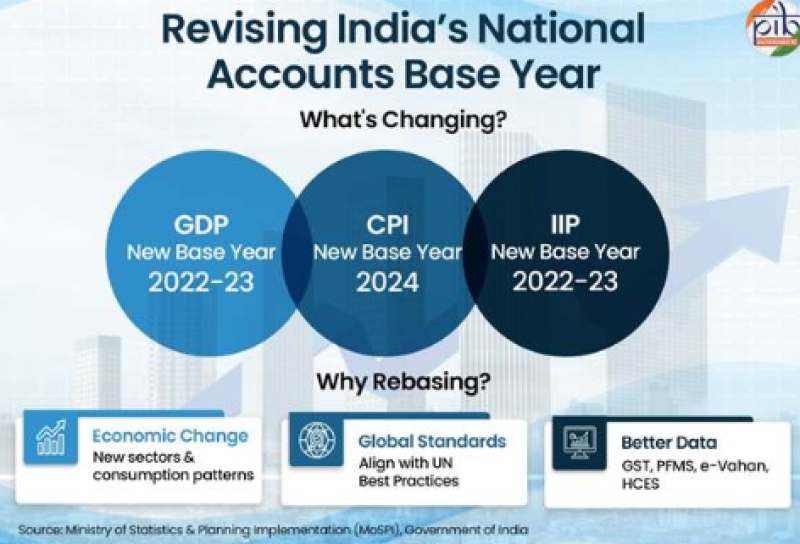
The base year for Gross Domestic Product (GDP) estimates is being revised to 2022–23, reflecting new economic structures.
The Consumer Price Index (CPI) base year has been updated to 2024, with revised consumption baskets and weights for both rural and urban households.
The Index of Industrial Production (IIP) is being aligned to the new national accounts series with 2022–23 as the base year.
Measurement of the informal sector has improved through quarterly QBUSE bulletins.
District-level estimates have become a core design feature in PLFS, ASUSE and NSS surveys.
Public access to official data has been expanded through GoIStats, e-Statistics and a revamped microdata portal, enhancing transparency and data reuse.
Why Modernisation Is Needed
Since the last base year revision in 2011–12, India’s economy has undergone significant structural changes. The services sector has expanded rapidly, formalisation has increased under the GST regime, and digital platforms have transformed business models. These shifts have created a need for more timely indicators, finer geographic detail and better coverage of the informal and services sectors.
To address this, the government has initiated wide-ranging reforms aimed at strengthening data quality, reliability and policy relevance. These include updates to GDP and price index base years, improvements in measuring the informal economy, enhanced labour market statistics, innovations in survey methods and technology, and greater stakeholder engagement.
Revision of the National Accounts Base Year
Periodic updates of the base year ensure that GDP and other macroeconomic indicators accurately reflect the current economic structure and relative prices. Such revisions incorporate new data sources, updated compilation methods and international best practices approved by bodies such as the United Nations Statistical Commission.
Aligning with updated global standards ensures that India’s data remain methodologically robust and internationally comparable, particularly in areas such as digital economy measurement and supply-use tables.
GDP Base Year Shift to 2022–23
One of the most significant reforms is the revision of the GDP base year from 2011–12 to 2022–23. Over the past decade, new industries such as renewable energy and digital services have emerged, alongside shifts in consumption and investment behaviour. Updating the base year is essential to accurately capture the real contribution of fast-growing sectors and changes in productivity and technology.
Increased digitisation has also enabled the use of richer administrative data sources, such as vehicle registration databases, the Public Financial Management System (PFMS) and GST data, which will improve the accuracy and granularity of national accounts.
Why 2022–23 Was Chosen
The year 2022–23 has been selected as it represents the most recent “normal” year following disruptions caused by the COVID-19 pandemic during 2019–20 and 2020–21, which temporarily distorted consumption patterns and industrial output.
Methodological Continuity with Improvements
GDP will continue to be compiled using production/income and expenditure approaches. While the overall framework remains unchanged, methodological refinements are being introduced in both nominal and real terms to improve aggregation under the production/income approach, as well as under the expenditure method.