

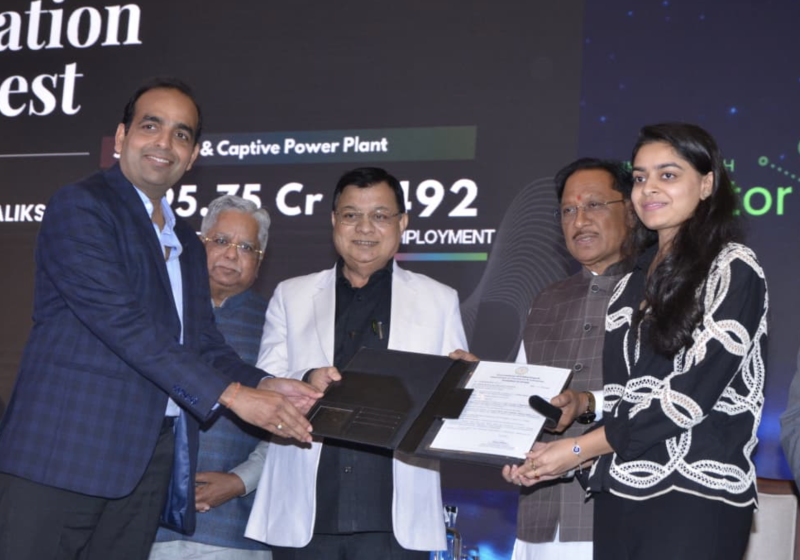
To advance the vision of a Developed India and a Developed Chhattisgarh, Chief Minister Shri Vishnu Deo Sai has introduced the new Industrial Policy (2024–30). Investor response indicates strong confidence in the state’s industry-friendly decisions, with increasing interest in setting up enterprises in Chhattisgarh. Between 1 January 2024 and October 2025, a total of 2,415 industries were established, bringing investments worth approximately Rs 18,058.34 crore and generating around 42,500 jobs. More than Rs 1,000 crore has been disbursed as subsidies to industries during this period.
Investment Promotion
The new Industrial Development Policy 2024–30 became effective on 1 November 2024. For the first time, the policy has been designed with a strong employment-oriented focus. Under the leadership of Commerce & Industry Minister Shri Lakhanlal Dewangan, the state has introduced training subsidies, EPF reimbursements, and customised incentive packages for units generating over 1,000 jobs.
To attract labour-intensive industries, amendments made on 27 May 2025 introduced an Employment Generation Subsidy and an Employment Multiplier framework. The list of eligible service sectors under the policy has been expanded to 43 to boost investment in the services industry.
Tourism and healthcare services have been included in the industrial policy for the first time. To promote high-quality education and sports training, amendments made on 27 May 2025 brought private schools, India’s top 100 and foreign universities, and private residential sports academies under the policy.
To promote the policy and attract investments, Investor Connect programs were held in Raipur, Delhi, Mumbai, Bengaluru, Osaka, Jagdalpur, and Ahmedabad.
As a result of these efforts, the state has received investment proposals worth approximately Rs 7.69 lakh crore across sectors such as steel, power, semiconductors, textiles, IT, BPO, and clean energy. In Nava Raipur, proposals worth Rs 11,000 crore have been received for establishing the country’s first AI Data Centre and semiconductor manufacturing facilities. The setup process is underway.
Ease of Doing Business
With a focus on reducing compliance burden, the state has identified 1,167 complex compliances. Of these, 231 provisions have been decriminalized, 369 processes have been digitised, 194 have been simplified, and 14 redundant provisions have been removed.
Out of 716 business-focused compliances, 117 provisions were decriminalized, 231 processes digitised, 153 simplified, and redundancy removed in 14. Additionally, 451 citizen-focused compliances have been streamlined, including 114 decriminalized provisions, 138 digitised processes, and 41 simplified provisions.
These initiatives aim to create a seamless, industry-friendly environment to encourage business expansion and growth. Under the Business Reform Action Plan (BRAP), rules and procedures across departments have been simplified. Relevant regulations have been amended to allow women to work safely in 24×7 operational shifts. The state has implemented 435 BRAP reforms and emerged as a top achiever across four national categories.
A total of 82 district-level reforms were identified, of which 124 have been implemented. A new Single Window System, developed as per Government of India guidelines, was launched on 1 July 2025.
To decriminalize minor offences across various state laws, the Chhattisgarh Jan Vishwas Provisions Amendment Act 2025 was passed during the Monsoon Session of the Legislative Assembly. Through this Act, 163 provisions across eight Acts have been decriminalized, making Chhattisgarh the second state in the country to pass such legislation.
For greater transparency and competitiveness in industrial land allocation, amendments have been made to the Chhattisgarh Land Allocation Rules. Land in industrial areas is now allotted through e-tendering instead of the earlier first-come, first-served system.

