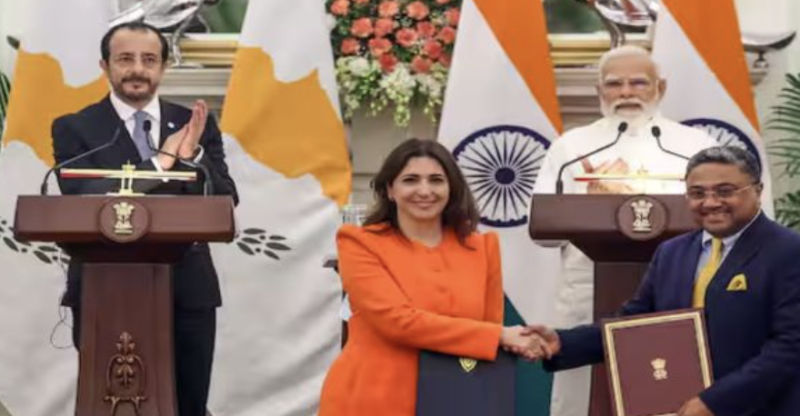
India and Cyprus have agreed to establish a Joint Working Group on Counter Terrorism and elevate bilateral relations to a Strategic Partnership following high-level talks between Prime Minister Narendra Modi and Cyprus President Nikos Christodoulides in New Delhi.
During the bilateral meeting, both leaders strongly reiterated their commitment to combating terrorism in all its forms, including cross-border terrorism. Cyprus expressed solidarity and unwavering support for India’s fight against terrorism.
Briefing the media, Sibi George said counter-terrorism emerged as a key pillar of discussions, with both nations unequivocally condemning recent terror attacks, including the Pahalgam attack and the incident near the Red Fort. The leaders emphasized that perpetrators of terrorism must be held accountable through coordinated international efforts aligned with international law.
Key Outcomes of the Bilateral Talks
- India and Cyprus elevated ties to a Strategic Partnership
- Agreement to establish a Joint Working Group on Counter Terrorism
- MoU signed on diplomatic training cooperation
- Launch of a Cyber Security Dialogue
- Establishment of a Consular Dialogue
- Roadmap finalized for Defence Cooperation (2026–2031)
- Cyprus joined the Indo-Pacific Oceans Initiative
The discussions also covered trade, investment, maritime security, financial connectivity, innovation, education, culture, mobility, and India-EU engagement.
Economic & Strategic Significance
Cyprus remains an important economic partner for India and is currently among the top foreign investors into the country. According to the Ministry of External Affairs, Cyprus is the ninth-largest source of FDI inflows into India and the second-largest among EU nations after the Netherlands, contributing nearly USD 16 billion since 2000.
Defence and maritime cooperation also emerged as major strategic pillars. A structured bilateral defence cooperation programme for 2026 has already been signed in Nicosia to deepen long-term defence collaboration.
Both countries will commemorate 65 years of diplomatic relations in 2027 through a series of bilateral events and initiatives.