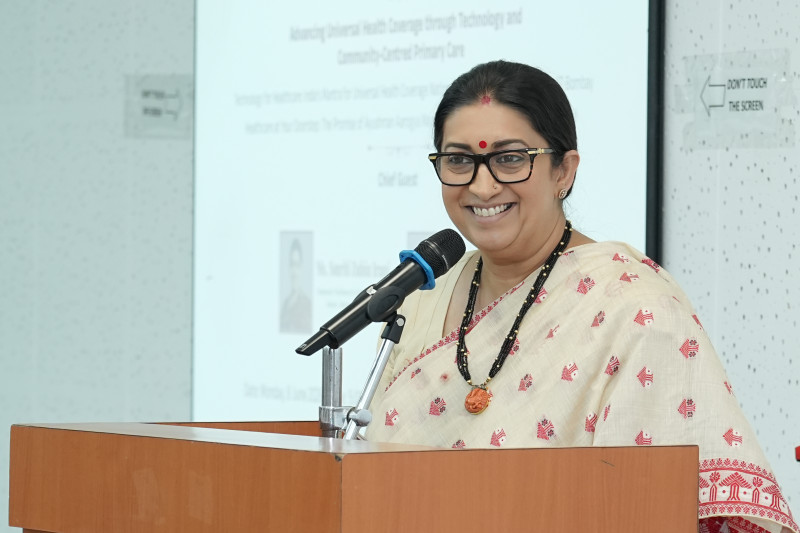
9 June, Bengaluru, 2026: The fifth edition of Bringing Evidence into Public Health Policy (EPHP) 2026 was inaugurated at IIM Bangalore earlier today, bringing together policymakers, health professionals and change agents to deliberate on the theme, ‘Future-Focused Health Systems in a Changing Context’. Day one of the national conference set the tone for three days of keynotes, panel discussions, workshops and dialogues aimed at forging stronger connections between evidence, policy and practice.
The conference was inaugurated in the presence of public health leaders and researchers across India and the Asia Pacific region.
The latest edition of the conference is being organized by the T.T. Narasimhan School of Advanced Studies at IPH Bengaluru in partnership with Health Systems Global (Asia Pacific Region); The George Institute for Global Health; IIM Bangalore, under the aegis of Prof. Arnab Mukherji, faculty of the Public Policy area and Chairperson of the PGPPM programme at IIMB, who serves as co-organizer of the conference; and the Institute of Tropical Medicine Antwerp.
New IIMB-led study highlights promise of Ayushman Aarogya Mandirs in strengthening primary care
As India advances towards the twin aspirations of Ayushman Bharat and Viksit Bharat, the future of universal health coverage may well depend on the strength of healthcare delivered closest to communities. This emerged as a central theme at the launch of ‘Healthcare at Your Doorstep: The Promise of Ayushman Aarogya Mandirs’, a report prepared by IIM Bangalore in collaboration with IIM Udaipur, IIM Shillong and IIM Ranchi, during the Emerging Perspectives in Health Policy and Healthcare (EPHP) Conference hosted at IIM Bangalore.
The IIM-led study examined how Ayushman Aarogya Mandirs (AAMs) are reshaping the delivery of comprehensive primary healthcare across diverse geographies and health systems.
Presenting the report, Dr. Alacrity Muksor, Post-Doctoral Fellow at IIM Bangalore, noted that the study sought to understand the functioning of AAMs, identify key implementation and management challenges, and generate evidence-based recommendations for strengthening Comprehensive Primary Healthcare (CPHC). Conducted across Karnataka, Meghalaya, Mizoram, Jharkhand and Rajasthan, the stakeholder-centred qualitative study drew insights from 11 districts, 13 focus group discussions and 93 participants.
The findings highlighted the significant expansion of services delivered through AAMs beyond traditional primary healthcare functions. In addition to maternal and child health services and immunization, AAMs were found to provide non-communicable disease care, mental health services, geriatric and palliative care, teleconsultation, and preventive health interventions.
The report also documented state-specific innovations in implementation. Karnataka demonstrated stronger continuity of care through facility-based service delivery and localized teleconsultation models. Meghalaya and Mizoram adapted service delivery to linguistic, cultural and geographical realities, while Jharkhand expanded screening services and Rajasthan evolved context-sensitive approaches suited to tribal, desert and urban populations.
The session saw the release of a second report titled ‘Technology for Healthcare: India's Mantra for Universal Health Coverage’, prepared by the National Disease Modelling Consortium (NDMC) at IIT Bombay. Developed through a series of multidisciplinary stakeholder consultations across the country, the report examines how digital technologies, disease modelling and data systems can accelerate progress towards universal health coverage. The report highlights India's growing strengths in frontline health technologies, surveillance and modelling capabilities, and digital health infrastructure, while identifying key areas for improvement, including health-data governance, interoperability, responsible AI adoption and workforce capacity building.
Intent and a pathway challenged by a trust deficit
Launching the reports, Ms. Smriti Zubin Irani, former Cabinet Minister, Chairperson of the Alliance for Global Good – Gender Equity and Equality, and Advisor to the Women's Collective Forum, urged stakeholders to move beyond publication towards implementation.
“We opine, we examine, we publish, and that suffices. The real challenge is to model these findings for real-life and real-time implementation”. Reflecting on the findings across both reports, she observed that India's challenge was no longer a lack of resources or intent, but the absence of cohesive execution.
“There is intent, there is a pathway, and there is an aim. The only thing lacking is an implementable plan”. On things that stood out from the report collated by IIT Bombay, she noted there wasn’t a deficit in the availability of technology, but there was a severe absence of trust. “I defer from the notion that trust will be generated over time. I believe challenges in the future are aplenty and trust will be most hit by deficit”.
On the newly available National Family Health Survey (NFHS-6) data, reported upon widely but not reflected upon widely, she said, “We tend to read numbers only when they make for a death wish, or when they are designed to proclaim death either of an idea or a principle or a program”, adding that this is the fundamental challenge that presses on the institution of reliability when it comes to data.
She called for closer collaboration between research institutions, policymakers and implementation agencies to translate evidence into actionable health outcomes, particularly in states facing persistent public health challenges.