

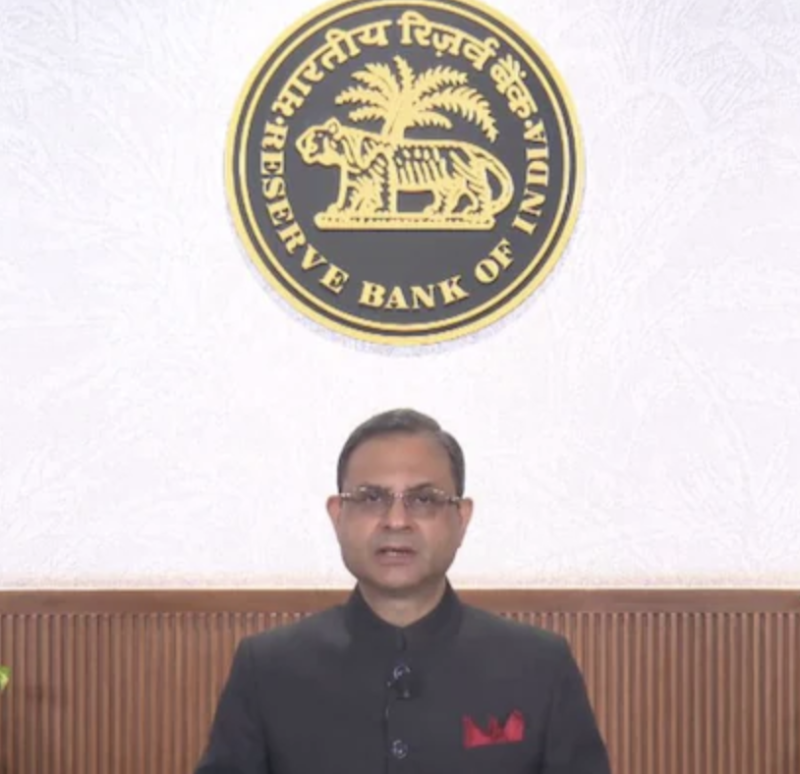
The Reserve Bank of India’s latest Monetary Policy Committee (MPC) decision—cutting the repo rate by 25 basis points to 5.25 percent—has been hailed as a prudent step made possible by India’s exceptionally low headline inflation of 0.3 percent in October 2025, the lowest since the adoption of flexible inflation targeting. Governor Sanjay Malhotra described this as a “rare Goldilocks period,” with inflation at 2.2 percent and growth at 8.0 percent in H1 FY26. On the surface, the characterization feels justified.
Yet, the deeper numbers—especially those the MPC mentions only in passing—tell a more complicated story. India is entering a phase where domestic macro stability and global turbulence are pulling in opposite directions. The rate cut is defensible, but the comfort it signals may be premature.
A Disinflation Story Built on Highly Volatile Foundations
October’s 0.3 percent inflation print is a statistical outlier shaped overwhelmingly by food price deflation of –3.7 percent, not a broad-based easing. Breaking it down:
- Vegetable prices collapsed by –27.6 percent
- Cereals fell –16.2 percent
- Spices dropped –3.3 percent
These declines stem from one favourable monsoon cycle, adequate reservoir levels at 87.8 percent of capacity, and rabi sowing up 9.9 percent—all weather-dependent gains. As recent years have shown, agricultural inflation can snap back in a single month of climatic disruption.
Moreover, core inflation remains sticky at 4.3–4.4 percent, with precious metals alone adding 50 bps of upward pressure. The RBI itself forecasts inflation rising to 3.9 percent in Q1 FY27 and 4.0 percent in Q2, indicating that this ultra-low inflation window is temporary at best.
The MPC’s confidence rests on assumptions that global food, fertilizer, and energy prices will remain benign. But the World Bank’s commodity outlook already warns that geopolitical tensions and supply disruptions could reverse softening trends abruptly. India’s food-led disinflation is, therefore, not a structural achievement—it is a fragile, rain-dependent reprieve.
Growth Is Resilient, But Its Pillars Are Weakening
India posted 8.2 percent GDP growth in Q2 FY26, the highest in six quarters. Domestic consumption remains steady, government capital expenditure is robust, and corporate balance sheets are healthier than at any time in recent memory.
Yet the headline masks troubling fractures underneath.
Exports Have Re-entered Contraction
India’s merchandise exports fell 11.8 percent YoY to $34.38 billion in October 2025 after a few quarters of marginal improvement. This is not a cyclical wobble—it is the first clear transmission of global tariff pressures into India’s export engine:
- Exports to the US fell from $6.9 billion to $6.3 billion.
- Non-petroleum, non-gems & jewellery exports declined from $31.32 billion to $28.14 billion.
- India’s share in US imports of precious stones collapsed from 37 percent to 6 percent, while competitors like Australia rose from 2 percent to 9 percent.
- Manufacturing PMI slipped from 59.2 in October to 56.6 in November—the slowest improvement in operating conditions in nine months.
- New export orders hit a 13-month low.
These are structural signals, not statistical noise.
Services Exports Are Strong—but Vulnerable
India’s services exports rose to $237.55 billion for April–October, up from $216.45 billion, generating a surplus of $118.68 billion. But the cushion they provide is increasingly fragile:
- Global tech spending is slowing.
- Multinationals are reassessing offshoring strategies because of geopolitical blocs.
- Future US tariff packages, if negotiations falter, may no longer spare IT and business services.
Services cannot indefinitely offset a contracting goods sector in a fracturing global trade system.
The Rupee, External Sector & Capital Flows: Pressure Is Building
The rupee’s depreciation—from ₹88.80 to ₹90.43 per USD—marks a 5 percent YTD decline, the worst performance among major Asian currencies.
FPIs Are Voting With Their Feet
Foreign portfolio investors have withdrawn ₹1.48 lakh crore ($17.7 billion) from equities in 2025 alone. This is occurring at a time when India boasts low inflation, high growth, and record foreign exchange reserves—a contradiction that signals investors’ deeper concerns about external risks and trade uncertainty.
Trade Deficit Hits an All-Time High
India’s monthly trade deficit touched a record $41.68 billion in October 2025:
- Gold imports soared to $14.7 billion, up nearly 200 percent.
- Merchandise imports for April–October reached $451.08 billion, up from $424.06 billion.
- Export growth in the same period was negligible at $254.25 billion, resulting in a cumulative merchandise deficit of $196.82 billion.
The current account deficit temporarily improved to 1.3 percent of GDP, but only because of strong services exports and remittances—both exposed to global volatility.
Forex Reserves: Strong, But Not Infinite
India’s reserves at $686.2 billion offer an 11-month import cover. But with the RBI intervening more frequently to manage rupee volatility, this buffer may erode faster if external shocks intensify.
BFSI Sector: Stable, but Entering an Uncertain Credit Cycle
India’s BFSI sector has grown almost 50× in market cap over two decades, now valued at ₹91 trillion and contributing 27 percent of GDP.
Yet beneath this strength lie emerging risks:
- The RBI’s easing cycle has reduced fresh deposit rates by 105 bps, compressing bank margins.
- Credit growth remains high at 11.4 percent YoY, even as export-oriented sectors face declining revenue visibility.
- Construction indicators sluggish: steel consumption up only 2.4 percent, cement production 5.3 percent.
- If external demand weakens further, today’s benign NPA ratio of 2.05 percent could reverse sharply within 12–18 months.
The danger is that the rate cut fuels lending into sectors whose real profitability is becoming increasingly uncertain.
Geopolitics and Trade Fragmentation: The Decisive External Risk
The global context is the single largest blind spot in the MPC narrative. India is operating in a world where:
- The Trump administration has imposed 27 percent reciprocal tariffs on Indian goods, plus 25 percent punitive tariffs on Russian-linked crude purchases.
- EU–India FTA negotiations remain unresolved on key issues like steel, cars, and services.
- The World Economic Forum warns that an escalated trade war could contract global GDP by more than 0.50 percent, exceeding the 2018–2020 US-China shock.
Should US–India trade talks fail in December, India could see:
- A 15–20 percent contraction in merchandise exports.
- The rupee breaching ₹95/USD.
- FPIs accelerating outflows.
- GDP growth slipping toward 5.5–6.0 percent within quarters.
The MPC acknowledges “external uncertainties” but still labels risks as evenly balanced. They are not. External risks far outweigh domestic ones.
A Decision That Makes Sense—But at the Wrong Time?
The rate cut is justified given today’s data. But it may be mistimed given tomorrow’s risks.
If external conditions worsen, the RBI may face a policy trap—forced to tighten to defend the rupee or fight imported inflation, even as growth deteriorates. That is the danger of using monetary space prematurely.
Conclusion: The Goldilocks Narrative Is Seductive—But Illusory
India’s domestic indicators look reassuring—low inflation, robust growth, strong financial buffers, resilient corporates. But the global economic architecture is shifting beneath our feet far faster than domestic policy acknowledges.
The real test for India’s policymakers will not be managing food prices or liquidity. It will be navigating a world where trade norms unravel, capital flows become volatile, and geopolitical blocs re-draw supply chains.
The Goldilocks moment is not false—but it is fleeting. Policymaking must reflect that reality before the comfort of today becomes the vulnerability of tomorrow.
By Rohit Kumar Singh, Ph.D. (Eco).
