

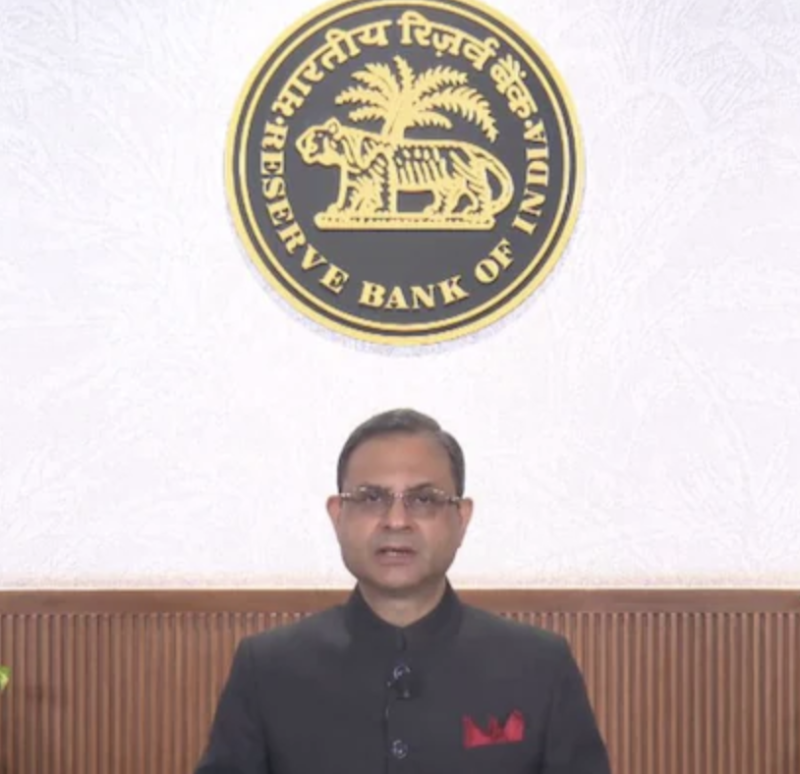
Every once in a while, the RBI delivers a policy decision that seems small on the surface but speaks volumes about where the economy stands. The quarter-point cut announced this week — bringing the repo rate down to 5.25% — is one such moment. It isn’t the rate cut itself that matters; it’s the macro backdrop against which it has been announced.
Think about what has happened over the past few months. Inflation, which usually keeps India awake at night, didn’t just cool — it collapsed. The October CPI number was 0.3%, and the July–September quarter averaged 1.7%, slipping below even the lower band of the RBI’s target. Food prices, often the villain, turned unusually friendly: vegetables down 27%, cereals down 16%. This isn’t the slow grind of disinflation. It’s a sudden release of pressure.
At the same time, growth didn’t slow down as many expected. Q2 GDP printed 8.2%, with industry and services doing the heavy lifting and consumers spending confidently during the festival stretch. When inflation is near zero and growth is above 8%, monetary policy is no longer about firefighting. It becomes a tool to smoothen the journey ahead — and that is precisely what the RBI is attempting.
The central bank’s liquidity actions underline that intent. A ₹1-lakh-crore OMO purchase and a USD 5-billion swap are not routine housekeeping moves. These are measures to ensure the financial system has enough strength to support the next phase of growth. Already, banks have lowered new lending rates by 70 basis points, and it is clear that the Reserve Bank of India wants the trend to continue.
For businesses, this is a rare alignment of stars. Capacity utilisation is edging above 74%, a level at which investment conversations usually begin to sound serious. Non-food credit to sectors like engineering goods (+25%) and base metals (+13%) suggests companies have already begun preparing for a larger cycle. Add to this the bump in GST revenues, the improvement in rural appetite (two-wheeler sales jumped 52% in October), and the steady return of private capex — you get an economy that is not waiting for policy support but will benefit from it.
The financial sector is probably in its strongest position in a decade. Bank NPAs are down to 2.05%, capital ratios look healthy, and liquidity cushions are intact. NBFCs, too, are well-capitalised, even if the squeeze in margins is visible. But the regulator is not letting comfort drift into complacency. The sudden rise in customer complaints and the RBI’s decision to launch a clean-up drive is a reminder that stability is built not only on balance sheets, but also on behaviour.
Where the picture becomes complicated is outside our borders. India’s current account deficit has improved to 1.3% of GDP, thanks to strong services exports (+8.8%) and remittances (+10.7%). But merchandise trade is slipping the other way. October’s numbers were stark: exports fell 11.9%, imports surged 16.9% to $76.1 billion, and the trade deficit widened to $41.7 billion. That is not something to gloss over.
This mismatch between strong domestic fundamentals and a weakening global environment is the real story. The RBI can manage rates, liquidity and expectations — but it cannot solve disrupted shipping lines, geopolitical stand-offs, or the patchy demand in major markets. What it can do, however, is keep the domestic engine humming while India works to secure its trade future. The mention of ongoing trade negotiations in the policy statement was not incidental. In a world where supply chains keep re-drawing themselves, FTAs have become economic insurance policies.
India enters 2026 with its best macro starting point in years: low inflation, solid growth, resilient banks, a recovering consumer, and $686 billion of reserves providing strategic comfort. But this window won’t stay open forever. The global environment is not benign, and fragmentation in trade and technology could reshape the playing field faster than markets anticipate.
The central bank has done what it can — ease the cost of money without losing prudence. The onus is now on companies, various ministries, and trade negotiators. If the business community in India takes advantage of the time and makes new investments, if agreements on trade are locked away so that guaranteed market accessibility is established, and if the finance sector maintains sanity while increasing lending, then the goldilocks moment could turn into a sustained era of expansion.
For now, the RBI has simply nudged the economy forward. What India does with that nudge will define the story of the next year.
- Anamika Singh and Suketu Thanawala, StraCon Business Advisory and Consultancy Firm.

