

Shanghai is witnessing a sharp rise in interest and demand for artificial intelligence (AI) trainers, a newly recognised profession that has been officially listed as an “occupation in short supply” in the city, reflecting the accelerating integration of AI across industries.
On a recent weekend, dozens of white-collar professionals gathered in a Shanghai office building for a hands-on AI training session, highlighting how working professionals are increasingly seeking structured pathways to enter the AI ecosystem. Recognised in China’s national occupational catalogue, AI trainers act as crucial intermediaries between humans and machines, helping AI systems translate real-world requirements into functional models.
Many participants come from non-technical backgrounds. Chen Ke, who has no formal training in computer science, said the decision to enrol came after discovering the course on social media. He noted that systematic training and practical exercises helped break down complex AI concepts, enabling even beginners to acquire usable skills.
The programme is run by an industry-training integration skills development centre supported by the Shanghai municipal government. According to its general manager Pan Pan, the course structure prioritises practice, with 70 percent hands-on training and 30 percent theory, and is designed primarily for working professionals attending weekend sessions. Course content is continuously updated to reflect real industry scenarios and evolving technological needs.
For others, AI training supports career transitions. Yi Zhou, a researcher at a Japanese pharmaceutical R&D company, said structured AI education has helped him move beyond superficial online learning. He now applies AI models to predict key indicators in drug research, significantly improving efficiency in biopharma development.
Enterprises are also actively recruiting certified AI trainers. At Shanghai Ideal Information Industry (Group) Co., Ltd., AI trainers play a critical role in the final stages of AI deployment, overseeing data annotation, model optimisation, and quality control. However, talent shortages persist.
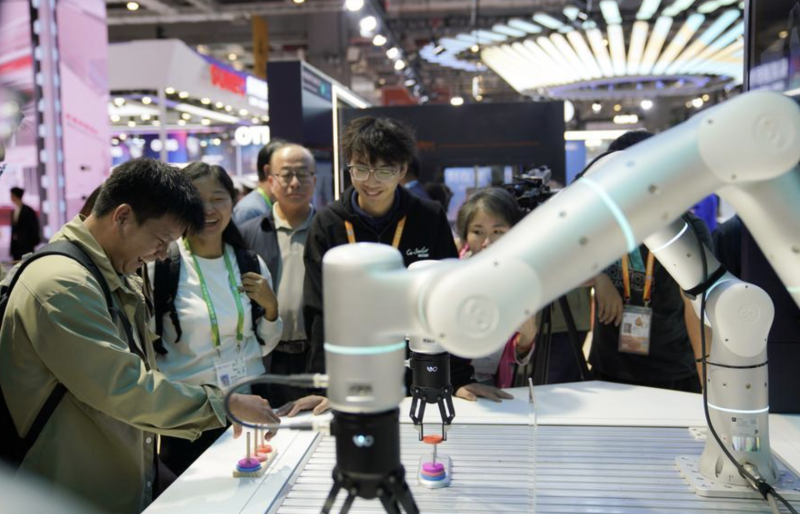
Photo credit- A visitor plays a game with an AI robot arm at the Intelligent Industry and Information Technology exhibition area of the eighth China International Import Expo (CIIE) in east China's Shanghai, Nov. 6, 2025. (Xinhua/Fan Yuqing).

