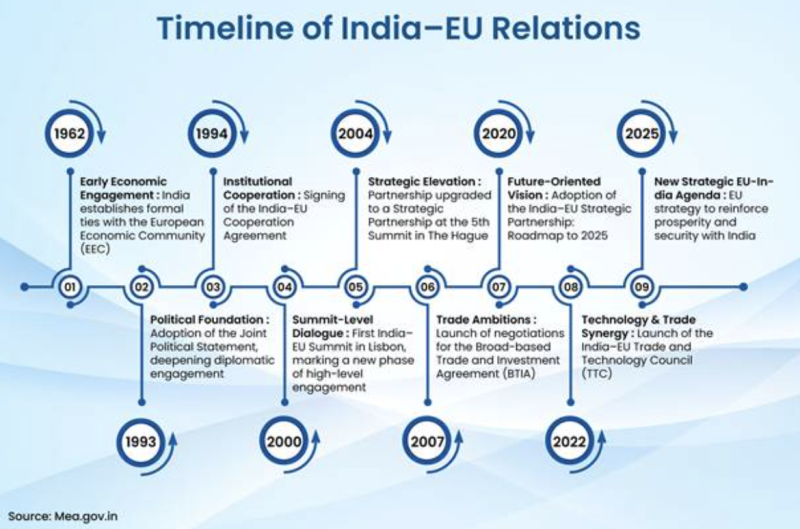
India–European Union relations have entered a phase of renewed strategic momentum, with both sides intensifying high-level engagement ahead of the forthcoming India–EU Summit in New Delhi. The renewed push is focused on advancing the long-pending India–EU Free Trade Agreement (FTA) negotiations and adopting a new Joint Strategic Agenda to guide the partnership beyond the existing roadmap.
This engagement reflects a shared commitment to expand cooperation across trade and investment, clean and green energy, science and technology, security and defence, digital initiatives, connectivity, space, agriculture, and people-to-people exchanges.
High-level political contacts have strengthened markedly in recent years. A key milestone was the visit of the EU College of Commissioners, led by President Ursula von der Leyen, to New Delhi in February 2025—the first-ever such visit by the EU to a bilateral partner outside Europe. Leaders have also met regularly on the sidelines of multilateral forums such as the G7 and G20, most recently in Canada in June 2025, and have maintained frequent telephonic engagements, including calls between the Prime Minister of India, President von der Leyen, and European Council President Antonio Costa in September 2025.
Trade and Economic Ties at the Core
The India–EU relationship is anchored in shared democratic values, the rule of law, and a rules-based international order. The EU remains India’s largest trading partner in goods, with bilateral trade reaching about $136 billion in FY25. The EU is also among India’s top overall trading partners when goods and services are combined.
From 2019 to 2024, bilateral trade in services expanded steadily, with Indian services exports to the EU rising from EUR 19 billion to EUR 37 billion, while imports from the EU increased to EUR 29 billion. Machinery, transport equipment, and chemicals dominate EU exports to India, while Indian exports include machinery, chemicals, base metals, mineral products, and textiles.
From Frameworks to Action
The partnership has evolved from dialogue to execution, guided by the ‘India–EU Strategic Partnership: A Roadmap to 2025’, adopted in 2020. Key developments include the resumption of FTA and investment negotiations in May 2021 and the launch of the India–EU Trade and Technology Council (TTC) in April 2022. The second TTC ministerial meeting in New Delhi in February 2025 marked a shift toward actionable cooperation in digital and green technologies.
Defence, Security and Maritime Cooperation
India–EU defence and security cooperation has accelerated in 2025. During the February visit of the EU College of Commissioners, leaders agreed to explore a Security and Defence Partnership, supported by growing institutional and industry-level engagement. This included a December 2025 visit by the Society of Indian Defence Manufacturers to Brussels and the first-ever visit of the EU Political and Security Committee to India in September 2025.
Maritime cooperation has also strengthened through joint naval exercises in the Indian Ocean (June 2025), Gulf of Guinea (October 2023), and Gulf of Aden (June 2021), along with humanitarian escort operations near Somalia.
Clean Energy, Connectivity and Technology
Climate action and clean energy form a central pillar of the partnership, led by the Clean Energy and Climate Partnership (CECP), established in 2016 and expanded under Phase III in November 2024. Cooperation spans solar energy, offshore wind, methane emissions reduction, sustainable transport, and climate-resilient infrastructure, with the EU supporting initiatives such as the International Solar Alliance and CDRI.