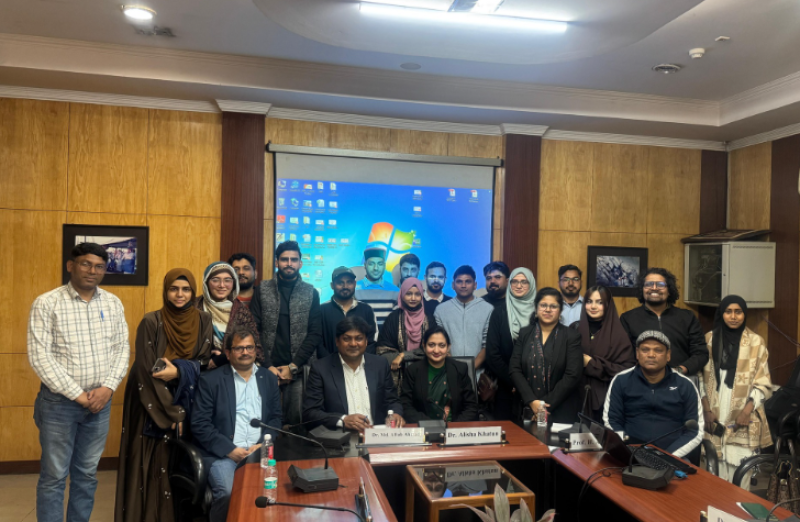
India Arab Cultural Centre Jamia Millia Islamia organized an extension lecture on “From Jahliya to Legal Reforms: The Evolution of Islamic Law and the Transformation of Status of Muslim Women” on Thursday, 5th April 2026. The event was chaired by Prof. Hemanyun Akhtar Nazmi, Director of Centre for West Asian Studies Jamia Millia Islamia and moderated by Dr. Md. Aftab Ahmad, Director of India Arab Cultural Centre Jamia Millia Islamia New Delhi which was conducted in the conference room of IACC.
Dr. Md. Aftab Ahmad director of IACC inaugurated the event by thanking honorable Vice Chancellor, Prof. Mazhar Asif and the Registrar Prof. (Dr.) Md. Mahtab Alam Rizvi for being generous enough to support and patronize such academic activities which enhance the debate and discussions among students and faculties. He also thanked Prof. Hemanyun Akhtar Nazmi for accepting his invitation to chair the session and enlighten the students with his expertise on this field. The director of the Centre along with introducing the theme of the lecture introduced the speaker, Dr. Alisha Khatun from the Faculty of Law and thanked her for agreeing to speak on the topic.
Introducing the topic to the audience chair of the session Prof. H. A. Nazmi highlighted the socio-cultural and as well as political condition of Arab society before Islam in general and the condition of women in particular. He believed that the after Islam, the condition changed hugely but in modern context there remains various things to be explored and interpreted to meet the needs prevalent in today’s society.
The speaker Dr. Alisha Khatun explored that the status of Muslim women has been shaped by a long historical evolution in the Islamic world—from the pre-Islamic era (Jāhiliyya), through the revelation of Islamic law (Sharīʿa), to modern legal reforms. While Jāhiliyya is often characterized by social customs that marginalized women, early Islamic teachings brought transformative changes, granting rights in marriage, inheritance, and economic life. Over centuries, Islamic legal interpretations (fiqh) and socio-cultural practices influenced women’s position in Muslim societies. In the modern period, legal reforms—often stimulated by colonial encounters, nationalism, and women’s rights movements—have further reshaped women’s rights and status.
The evolution from pre-Islamic practice to Islamic legal reforms demonstrates a trajectory of expanding rights for Muslim women, albeit shaped by historical, cultural, and political forces. Early Islamic law introduced significant protections and rights. Over centuries, juristic interpretations and social norms limited some freedoms. Modern legal reforms—driven by national legislatures and women’s movements—have further transformed women’s status, often reconciling religious principles with contemporary human rights ideals. The ongoing debates reflect the dynamic interplay between tradition, reform, and gender justice in Muslim societies.