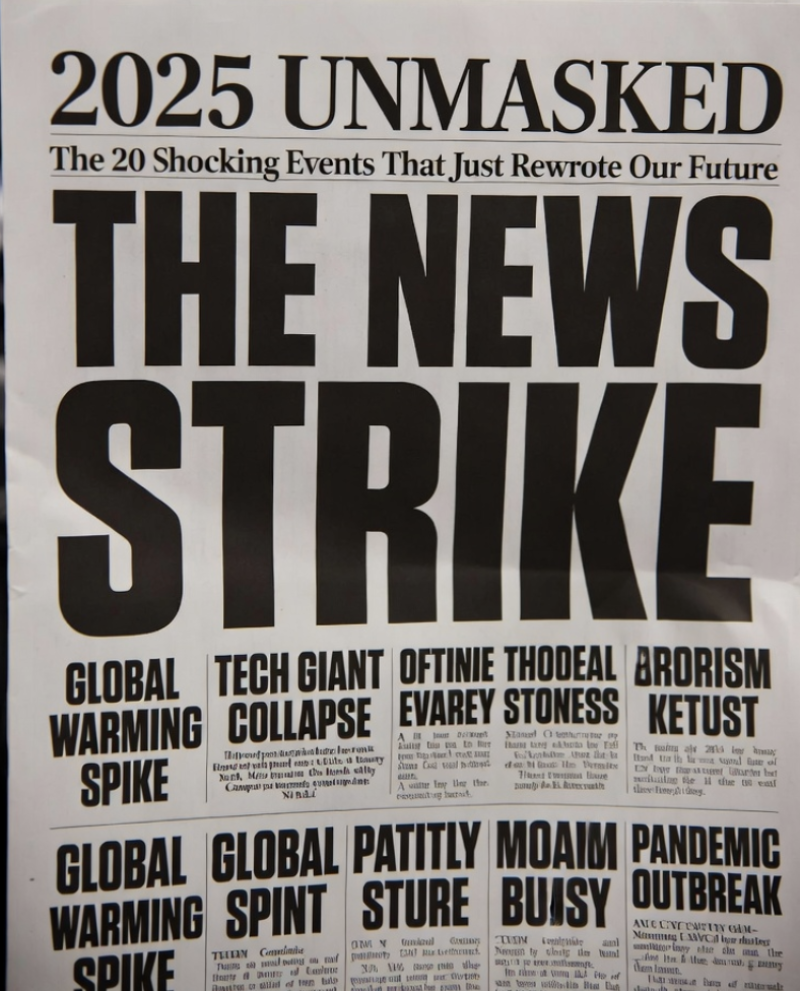
From a historic change in the Vatican to "Ego-Politics" in the White House and a catastrophic data breach that ended the era of passwords, 2025 was the year the "impossible" became our daily reality. These are the 20 defining moments that changed everything.
1. Trump’s "Ballroom" Presidency & The No Kings Protests
In January, Donald Trump returned to the White House with a "protectionist offensive." Beyond mass deportations and dismantling federal agencies, his literal demolition of the East Wing to build a 90,000-square-foot ballroom sparked the "No Kings" protests. Over 7 million people took to the streets in June and October, marking the most significant civil unrest in U.S. history and a nation locked in a battle over the soul of democracy.
2. Pope Leo XIV: The First American Papacy
On May 8, the world watched as Cardinal Robert Francis Prevost was elected the first-ever American Pope, taking the name Leo XIV. His election shifted the Catholic Church’s gravity toward the Americas. Leo XIV immediately faced the challenge of a church divided by progressive social movements and traditionalist pushback, signaling a new, unpredictable chapter for 1.3 billion Catholics worldwide.
3. The $40 Billion "Palisades" Inferno
January 2025 saw Southern California turned into a literal hellscape. The "Palisades" and "Eaton" wildfires became the costliest in history, causing $40 billion in insured losses. Fueled by record-shattering heat, the fires destroyed over 16,000 structures in Los Angeles. Scientists confirmed that human-caused warming has made such "once-in-a-century" disasters a terrifying new annual baseline.
4. Air India Flight 171: The Ahmedabad Tragedy
In June, the tail section of Air India Flight 171 wedged into a medical college in Ahmedabad, killing 241 people. It was a haunting image that stopped the nation. The tragedy, the first fatal crash of a Boeing 787, forced a global safety reckoning and a total overhaul of India’s aviation oversight, highlighting the cost of rapid industry expansion over safety.
5. Operation Sindoor: India-Pakistan War Alert
Following a brutal terror attack in Pahalgam in April, India launched "Operation Sindoor" in May—a series of surgical missile strikes. For four days, the two nuclear powers engaged in their most serious conventional war since 1999. Though a ceasefire was called on May 10, the suspension of the Indus Waters Treaty has left the region in a state of permanent "cold war."
6. The Gaza Famine & The "Uneasy" Ceasefire
After two years of bloodletting, an October ceasefire finally silenced the guns in Gaza. However, the victory felt hollow as a UN commission found that "genocidal conditions" and widespread famine had taken hold. While aid began to flow, the territory remains a landscape of ruins, and the world is now grappling with a humanitarian recovery effort estimated to take decades.
7. The 16-Billion-Credential Digital Apocalypse
June 2025 marked the "Death of the Password." A cyberattack of unheard-of proportions leaked 16 billion login credentials from Apple, Google, and Meta. This "Digital Pearl Harbor" rendered traditional security useless overnight. By year’s end, the global economy had been forced into a chaotic, mandatory migration toward biometric and "passkey" authentication to prevent total financial collapse.
8. Hurricane Melissa’s 185mph Path of Ruin
In October, Hurricane Melissa achieved "Monster" status, hitting Jamaica with 185 mph winds. It was the strongest Atlantic storm of the year, causing near-total destruction of the island's power grid and infrastructure. Melissa’s rapid intensification served as a grim warning that the warming Caribbean waters are now producing storms that bypass all historical categories.
9. Japan’s 7.6 Magnitude Tsunami Scare
On December 8, a massive 7.6 magnitude earthquake struck off Aomori, triggering a 70 cm tsunami. While Japan’s high-tech defenses held, the sheer scale of the tremor caused nationwide blackouts and panicked evacuations. It served as a stark year-end reminder that nature remains the ultimate superpower, even in the world's most prepared nation.
10. Asia’s First: Same-Sex Marriage Legalized
The year began with a massive win for human rights as Thailand became the first Southeast Asian nation to legalize same-sex marriage in January. Liechtenstein followed suit, making them the 37th and 38th countries globally to grant equality. The move was hailed as a "Rainbow Revolution," signaling a major cultural shift in regions long considered socially conservative.
11. The End of the 200-Year Vagrancy Act
In June, the UK finally scrapped the 1824 Vagrancy Act, which had criminalized homelessness for two centuries. This legislative victory shifted the national focus from punishing the poor to "Housing First" initiatives. It was a rare moment of social compassion in a year otherwise dominated by restrictionist immigration policies and mass deportations.
12. Vera C. Rubin’s "Dark Universe" Map
Astronomy entered its greatest era in June when the Vera C. Rubin Observatory released its first images. By mapping the entire visible sky every few nights, it has already revealed thousands of "killer asteroids" and provided the first real-time look at how dark matter shapes our galaxy, fundamentally altering our understanding of the cosmos.
13. The Hanoi Convention & High Seas Treaty
Environmentalists celebrated in September as 79 nations ratified the Global Ocean Treaty, turning 30% of the world’s oceans into protected sanctuaries. Simultaneously, the Hanoi Convention in Vietnam set new standards for "Strategic Autonomy," showing that even in a fractured world, nations can still unite to save the planet’s last wild frontiers.
14. Space for All: The First Wheelchair Astronaut
On December 20, Michaela Benthaus made history aboard a Blue Origin New Shepard as the first wheelchair user to enter space. Her mission proved that the "Final Frontier" is becoming accessible. Her research on microgravity's effect on physical disabilities is now seen as the first step toward a truly inclusive future in orbit.
15. The 10-Minute Louvre Jewelry Heist
In October, a gang using motorbikes and a "truck-mounted electric ladder" broke into the Louvre, stealing the French Crown Jewels in under 10 minutes. While suspects were caught, the 19th-century treasures remain missing. The heist exposed shocking vulnerabilities in museum security, leading to a multi-billion dollar "fortress" upgrade for global galleries.
16. Nepal’s Gen Z Revolution
Social-media-savvy protesters, led by the "TikTok Generation," successfully ousted Nepali Prime Minister K.P. Sharma Oli this year. Fed up with corruption and economic stagnation, the youth movement proved that digital activism could topple old-guard regimes, creating a template for Gen Z political power that is now spreading across South Asia.
17. Merz & the "New Germany"
On May 6, Friedrich Merz became Chancellor of Germany, steering the nation toward fiscal "hard-power" and stricter border controls. As the leader of the CDU, his victory signaled the end of the liberal-left coalition and a pivot toward a more assertive, "Germany-First" role within the European Union during a time of extreme economic tension.
18. The Myanmar Earthquake Disaster
A 7.7 magnitude earthquake struck Myanmar in March, killing over 5,300 people and causing $12 billion in damages. The tragedy was worsened by the country’s ongoing civil war, as the military junta and rebel groups initially blocked aid corridors. It remains the deadliest seismic event in the region in over a decade.
19. The Red Fort Terror Attack
In November, a devastating car bomb exploded near New Delhi’s historic Red Fort, killing 15. The attack, linked to a sophisticated terror cell, led to a nationwide security lockdown. It reignited fierce debates over domestic intelligence and has deeply influenced the political discourse regarding security and radicalization in modern India.
20. The IndiGo "Great Meltdown"
The year closed with a massive transportation crisis in India. IndiGo, the nation's aviation giant, cancelled thousands of flights in December due to a toxic mix of pilot strikes and new "Duty Time" regulations. Tens of thousands of holiday travelers were stranded, leading to a government inquiry that has put the future of "ultra-low-cost" flying in jeopardy.