India’s rural housing transformation under Pradhan Mantri Awas Yojana–Gramin (PMAY-G) has emerged as one of the country’s most significant welfare success stories, with the government now setting its sights on 4.95 crore total rural houses by 2029.
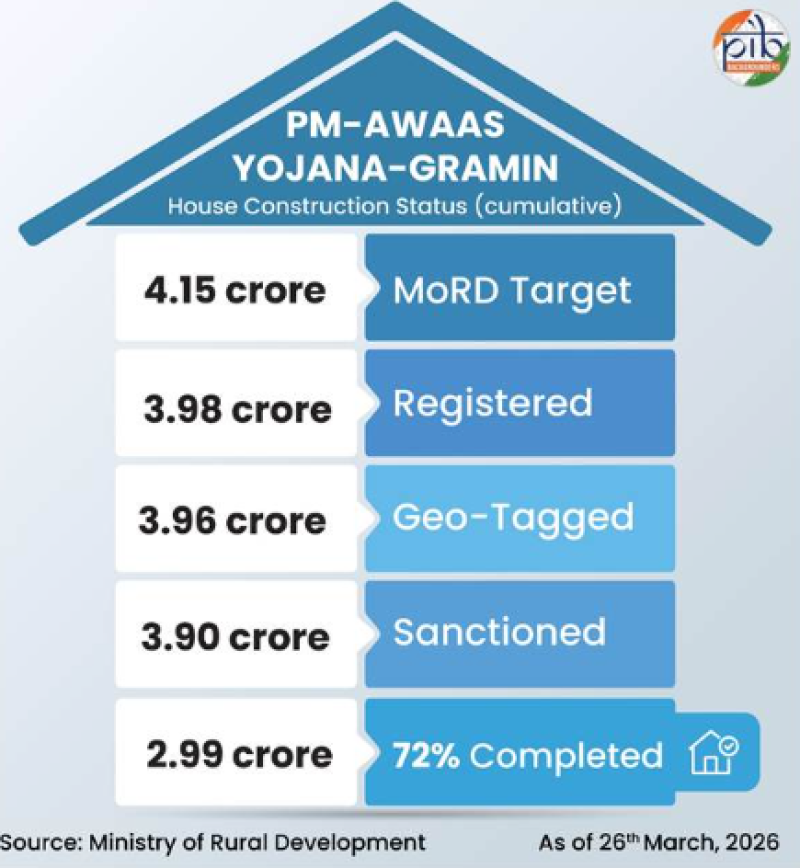
According to the latest update released on March 31, 2026, under Phase I and Phase II of PMAY-G, states have been allocated 4.15 crore houses, out of which 3.90 crore homes have been sanctioned and 2.99 crore houses have already been completed, marking substantial progress toward the “Housing for All” mission.
The Centre said that a cumulative ₹4,03,886.12 crore has been transferred directly to beneficiaries, ensuring timely construction support and reducing leakages through direct benefit transfer mechanisms.
Launched on April 1, 2016, PMAY-G aims to provide pucca houses with basic amenities to all houseless families and those living in kutcha or dilapidated homes in rural India. Each house under the scheme has a minimum built-up area of 25 square metres, including a dedicated cooking space.
A key differentiator in the scheme’s latest phase has been the use of AI-enabled monitoring and verification tools, including:
- Geo-tagging of houses
- Anomaly detection systems
- Aadhaar face authentication
- Digital progress tracking
These tools are helping improve transparency, beneficiary validation, and construction reliability, making PMAY-G one of the most tech-integrated welfare schemes in rural governance.
The housing programme has also significantly improved rural quality of life through convergence with major flagship schemes such as:
- Swachh Bharat Mission-Gramin
- Jal Jeevan Mission
- PM Ujjwala Yojana
- PM Surya Ghar: Muft Bijli Yojana
This convergence ensures that beneficiaries receive not just a house, but also toilets, clean cooking fuel, electricity, and drinking water access, turning PMAY-G into a broader rural lifestyle upliftment mission.
Human story behind the numbers
The government also highlighted the case of widow Taid from Titabor in Assam’s Jorhat district, who lived for years in a flood-prone vulnerable dwelling. With support under PMAY-G in 2016–17, she built a permanent house that now protects her family from floods and provides long-term dignity and stability.
Her story reflects the larger impact of PMAY-G: from shelter creation to social security, resilience, and hope for millions of rural families.