New Delhi, 17 February 2026
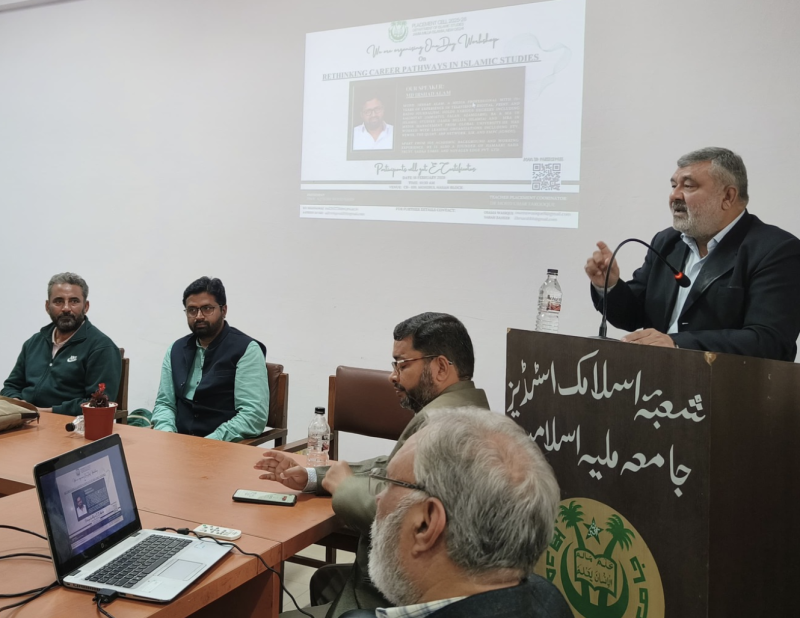
“There is no dearth of opportunities for students of Islamic Studies; rather, what is required is clarity of direction, effective planning, and consistent hard work.” These views were expressed by Md Irshad Alam, Founder of Hamari Sada Trust, Sada Times, and Novagen Edge Pvt. Ltd., New Delhi, during a lecture organized by the Placement Cell (2025–26) of the Department of Islamic Studies titled “Diverse Career Opportunities in Islamic Studies: A Reappraisal in the Light of Contemporary Demands.”
He emphasized that students should not confine their academic journey in the department merely to obtaining a degree. Instead, during their period of study, they should simultaneously prepare for central and state-level competitive examinations and equip themselves with various academic and professional skills so that they may emerge as capable, responsible, and productive citizens, contributing positively and effectively to society.
He further stated that faith, sincerity, hard work, and planning constitute the four fundamental pillars that guarantee success in this world and salvation in the Hereafter.
Presiding over the session, Professor Iqtedar Mohd Khan, Head of the Department of Islamic Studies and Dean, Faculty of Humanities and Languages, remarked in his presidential address that students must cultivate a spirit of inquiry, research, and critical thinking during their academic life. Although career prospects in the field of Islamic Studies may appear limited at first glance, the reality is that the field offers vast and diverse opportunities; what is needed is proper identification of these avenues and effective guidance.
He underscored that a student of Islamic Studies should hold the history of religion in one hand and a contemporary academic degree in the other; this combination alone can enable them to achieve success in both religious and worldly spheres.
Professor Syed Shahid Ali, former Head of the Department of Islamic Studies, observed that a student’s intellectual potential flourishes when he or she learns to ask questions, for questioning are the first step toward intellectual awareness. He added that avoiding ignorance and seeking proper guidance form the foundation of a student’s success.
In his vote of thanks, Dr. Mohd Umar Farooque, Coordinator of the Placement Cell, Department of Islamic Studies, stated that the primary objective of the program was to orient students toward effective planning for their future. He expressed hope that similar programs would continue to be organized in the future.
The program commenced with the recitation of verses from the Holy Qur’an by Wasim Ahmad, a student of the department. Mohammad Shehnawaz introduced the Placement Cell and the guest speaker, while the proceedings were conducted by Osama Wasiq.
Among those present on the occasion were faculty members of the Department of Islamic Studies including Mr. Junaid Haris, Dr. Mohammad Mushtaq, Dr. Mohammad Khalid Khan, Dr. Javed Akhtar, Dr. Anisur Rahman, Dr. Mohammad Usama, Dr. Nadeem e Sahar Anbareen, and Dr. Mohammad Masihullah, along with a large number of M.A. and B.A. students.
The successful organization of the program was made possible through the efforts of Khadija, General Secretary of Bazm-e-Talaba, and members of the Placement Cell including Mohammad Shehnawaz, Afreen Javed, Osama Wasiq, and Sara Zaheer.