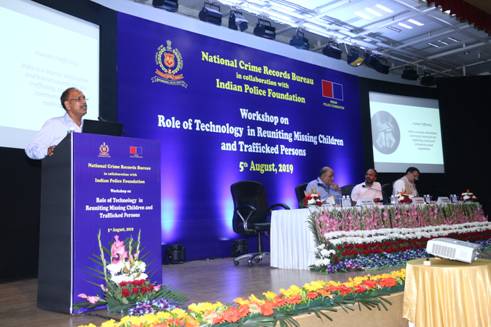
The National Crime Records Bureau (NCRB), under the Ministry of Home Affairs, in collaboration with the Indian Police Foundation (IPF), organised a workshop on the role of technology in reuniting missing children and trafficked persons.
The workshop focused on the growing role of advanced technologies such as biometrics, artificial intelligence (AI) and machine learning in improving identification processes and strengthening law enforcement efforts. Experts highlighted how modern biometric tools can help accurately identify missing persons, trafficked individuals and unidentified bodies, enabling faster reunification with families.
The discussions explored emerging technologies, particularly facial recognition systems, and their potential applications in criminal investigations, missing persons cases and public safety initiatives. Participants emphasised the need for secure, accurate and technology-driven solutions to support law enforcement agencies.
NCRB officials also outlined the Bureau’s future initiatives, including the Automated Facial Recognition System (AFRS), which is designed to assist investigating officers by automating the matching of photographs against records available in the Crime and Criminal Tracking Network and Systems (CCTNS) database.
Addressing concerns around privacy and security, NCRB clarified that AFRS will operate only on secured law enforcement databases and will serve as an investigative aid rather than a standalone decision-making tool. Any matches generated through the system will require further verification through conventional investigation and supporting evidence.
The workshop brought together experts from academia, government agencies and law enforcement to discuss the responsible use of technology in enhancing public safety and improving outcomes for missing and trafficked persons.