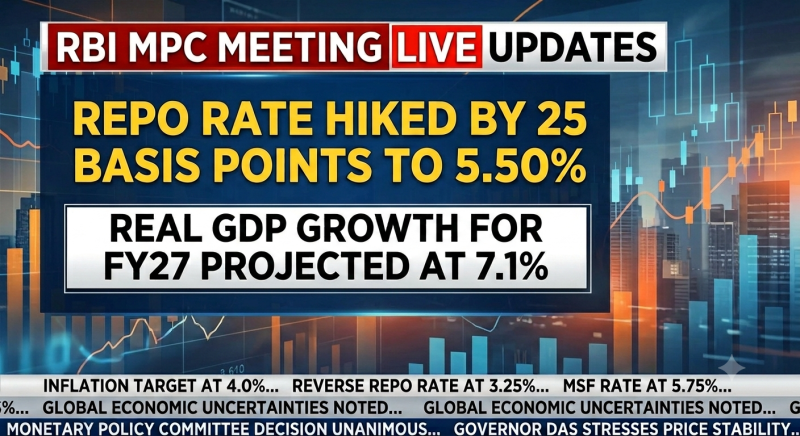
The Reserve Bank of India’s Monetary Policy Committee (MPC) unanimously raised the policy repo rate by 25 basis points to 5.50 per cent and changed its policy stance to calibrated tightening.
The Standing Deposit Facility (SDF) rate now stands at 5.25 per cent, while the Marginal Standing Facility (MSF) rate and Bank Rate have been adjusted to 5.75 per cent.
The RBI said inflation risks have increased amid geopolitical tensions, elevated global crude oil prices and broader price pressures. Headline CPI inflation is expected to average nearly 5.8 per cent over the next three quarters, while core inflation is projected at 4.4 per cent for FY27.
The central bank said rate cuts are off the table in the near term, with future policy action dependent on evolving growth and inflation conditions.
Despite global headwinds, the RBI maintained a positive outlook for the Indian economy, citing resilient private consumption, strong investment activity and broad-based services growth. Real GDP growth for FY2026-27 has been projected at 7.1 per cent, an upward revision of 40 basis points. Growth is projected at 7.2 per cent in Q2, 6.9 per cent in Q3 and 6.8 per cent in Q4.
The RBI projected CPI inflation at 5.2 per cent for FY2026-27, with inflation expected to rise to 6.0 per cent in Q3 and 5.7 per cent in Q4.
The RBI also announced interoperability among NBFC account aggregators and measures to include deposit-account information in consolidated account statements. It will also constitute a Technical Consultative Committee for Financial Markets to facilitate structured engagement with market participants and stakeholders.
MPC’s projected GDP growth for FY 27 of 7.1% reflects the resilience and strong macroeconomic fundamentals of the Indian economy. With the global monetary conditions remaining tight and inflationary expectations now projected at 5.2% forFY27, the RBI has also indicated a calibrated tightening by increasing the repo rate by 25 bps to 5.5% for managing India-US yield differentials. Indian Bank remains committed to support our customers through competitive lending rates and attractive deposityields through timely policy rate transmission. -Shri Binod Kumar, MD & CEO, Indian Bank.
“The RBI’s 25 basis point hike to 5.5%, its first since February 2023, will reach bonds, loans and deposits at different speeds. The bond market had moved ahead of the RBI. The 10-year government bond yield was already above 7% before today, so I don’t expect the hike on its own to move yields much further. Where yields go next depends on how the market reads the new tightening stance, along with liquidity, crude and the rupee. Borrowers will feel it next, as repo-linked home loans reset at least once every three months. Rates on new FDs should follow, though each bank sets its own pace,” said Nishchay Nath, Founder & CEO, BondScanner. “For retail investors, the practical step is to spread money across maturities rather than lock everything into one long tenure. Existing bondholders may see prices dip on paper, but a fixed-rate bond’s coupon and maturity value do not change. Beyond government bonds, a higher yield still has to be weighed against credit quality.”
Siddharth Agarwal, Founder & Managing Director, Mobicule Technologies, on the impact of the RBI’s 25 bps rate hike on borrowers, particularly households and small businesses with floating-rate loans.
Comment:
“A rate hike by 25 bps after an extended pause will quickly reach borrowers on floating-rate loans, either through higher EMIs or longer loan tenures. For households and small businesses already managing rising costs, this adds meaningful pressure. Lenders should inform borrowers of any revision before it takes effect, offer tenure extensions or restructuring where appropriate, and closely monitor early-stage delinquencies, where stress first becomes visible. The way lenders support borrowers during a tighter rate cycle has a lasting influence on repayment behaviour. In our experience working with banks, NBFCs and fintechs on collections and recovery, institutions that respond early to repayment signals emerge from rate cycles with stronger portfolios and fewer disputes.”
Mr Chanakya Chakravarti, Global Real Estate Investor and Capital Strategist
Quote:
This decision to increase repo rate reflects a considered effort to balance growth with price stability. For real estate, the immediate effect is a modest rise in financing costs, but the broader picture matters more. India's property market enters this phase with healthier balance sheets, lower leverage among developers, and strong end-user demand, particularly in the residential and office segments.
Investors will likely become more selective, favouring quality assets, credible sponsors and cash-flow visibility. Capital allocation will tilt towards projects with strong fundamentals rather than those reliant on cheap debt. Over the medium term, a credible commitment to price stability supports long-term investment, as predictable inflation and stable rates improve underwriting confidence for both domestic and global capital. The key will be clarity on the policy path. A measured, well-communicated approach should allow the sector to adjust smoothly while preserving India's appeal as an attractive real estate destination.
Mr. Pralay Mondal, MD & CEO, CSB Bank-
"The Repo rate hike is a prudent step in an uncertain global scenario. The underlying stress in inflation for the next few quarters warranted some steps in time to prevent further escalation. A rate hike would not be effective without calibrating theoperative rate to repo rate. However, RBI is expected to maintain adequate liquidity for smooth functioning of the money markets."
Divya Kumar Gulati, Chairman, CLFMA of India:
"The RBI’s assessment of inflation rising to 5.2%, alongside a widening trade deficit and heightened volatility in global crude prices, underscores the cost pressures that continue to affect India’s agri-food ecosystem. For the livestock and poultry sector, any sustained increase in energy, transportation and input costs can have a direct bearing on feed costs, at a time when farmers and producers are already operating in a highly cost-sensitive environment.
The impact also extends across the food manufacturing value chain, where higher logistics, processing, packaging and energy costs can raise the overall cost of production. Continued volatility in global commodity markets and the uncertain outlook for the West Asia region add another layer of pressure for businesses that depend on predictable input and supply-chain costs.
With maize, soybean meal and other feed ingredients already facing price and availability pressures, sustained energy inflation could further raise the cost of poultry, dairy and aquaculture production. As festive demand picks up, ensuring adequate domestic availability of feed raw materials will be important to prevent input-cost pressures from cascading into consumer prices.
The focus should therefore remain on strengthening feed security and keeping supply chains efficient, so that external global volatility does not impact farmers or the affordability of animal protein for consumers.”
Aayush Puri, CEO – Residential, ANAROCK Middle East-Quote:
The festive season is a crucial period for the residential real estate sector, and stability in interest rates would have further strengthened confidence among both homebuyers and developers. With buyer sentiment improving and housing demand remaining resilient, we expect the RBI to maintain a supportive stance in the near term. We remain confident that residential real estate will continue its steady growth trajectory, offering opportunities for both first-time homebuyers and seasoned investors. The festive season is likely to reinforce this momentum, supporting the sector’s growth through 2027.
Mr. Umesh Mohanan, ED & CEO at Indel Money, on the MPC’s decision:
“The RBI’s decision to raise the repo rate by 25 bps to 5.5% and adopt a calibrated tightening stance reflects its focus on containing inflation while maintaining the momentum of economic growth. With domestic economic activity remaining resilient and theRBI raising its FY27 GDP growth projection to 7.1%, the rate hike appears measured and aimed at keeping inflation expectations anchored without materially disrupting credit demand. The banking and NBFC sectors continue to remain well-capitalised, with creditgrowth holding up well.
For gold-loan NBFCs, the underlying demand environment remains encouraging. The 69% year-on-year growth in NBFC gold loans in August highlights the continued importance of gold-backed credit as a source of quick and secured liquidity for households and smallbusinesses. While higher interest rates may lead to some moderation in borrowing demand, the need for accessible secured credit remains strong. For lenders, the priority will be to maintain prudent underwriting, responsible growth and efficient service deliverywhile expanding access to formal credit.
The RBI’s move to enable greater interoperability among NBFC Account Aggregators is also a significant step for the sector. Improved access to consent-based financial information can help NBFCs strengthen credit assessment, streamline customer onboardingand enable faster, more informed lending decisions. This can ultimately improve both operational efficiency and the customer experience while supporting responsible growth across the NBFC ecosystem.”