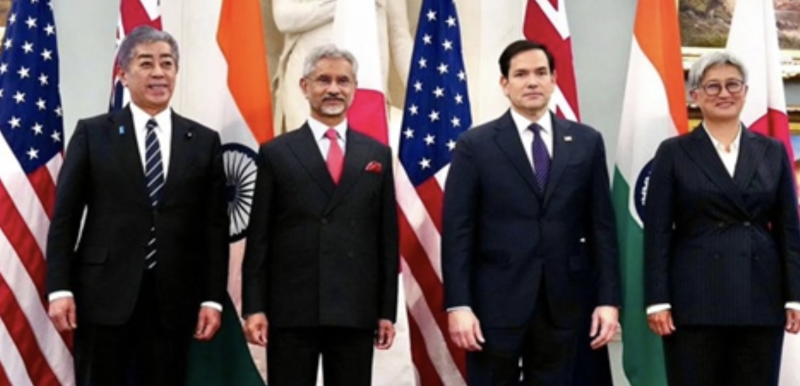
India is hosting the Quad Foreign Ministers’ Meeting in New Delhi today as leaders from the four-member strategic grouping gather to discuss regional security, Indo-Pacific cooperation, emerging technologies, and global geopolitical challenges.
External Affairs Minister Dr. S. Jaishankar will host:
- US Secretary of State Marco Rubio
- Australian Foreign Minister Penny Wong
- Japanese Foreign Minister Toshimitsu Motegi
The high-level meeting comes at a crucial time marked by rising uncertainty in West Asia, geopolitical realignments, and increasing strategic competition in the Indo-Pacific region.
Key Agenda Areas for Quad Talks
The ministers are expected to deliberate on:
- Strengthening a “Free and Open Indo-Pacific”
- Maritime security & regional stability
- Critical and emerging technologies
- Supply chain resilience
- Climate change cooperation
- Health security initiatives
- Maritime domain awareness
- Strategic coordination on global conflicts
The discussions will also review progress made since the previous Quad Foreign Ministers’ Meeting held in Washington DC last year.
Why This Meeting Matters
The Quad — comprising India, the United States, Australia, and Japan — has evolved into one of the most influential strategic partnerships in the Indo-Pacific.
The timing of the meeting is strategically significant because:
- US-Iran tensions have escalated sharply
- Global energy security concerns are rising
- China’s assertiveness in the Indo-Pacific remains a major geopolitical factor
- Supply chain diversification and technology alliances are becoming central global priorities
India’s Strategic Position Strengthens
India hosting the Quad meeting reinforces its growing role as:
- A balancing power in the Indo-Pacific
- A diplomatic bridge between major global blocs
- A key voice on maritime security and regional stability
The meeting also underlines New Delhi’s expanding strategic engagement with Washington, Tokyo, and Canberra amid shifting global power equations.
Strategic Signals to Watch
Markets and geopolitical observers will closely track:
- Any joint statement on Indo-Pacific security
- Cooperation in semiconductors, AI, and critical minerals
- Maritime and defence collaboration announcements
- Language around regional stability and supply chains
- References to West Asia tensions and energy security
The Quad continues positioning itself not merely as a security alliance, but as a broader strategic coalition focused on economic resilience, technology cooperation, and regional stability across the Indo-Pacific.