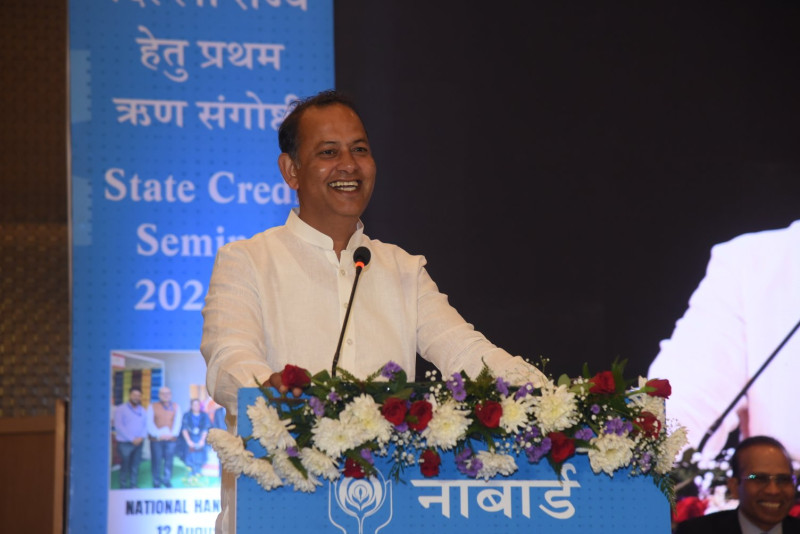
New Delhi | 13 April 2026
In a landmark initiative for Delhi’s credit planning and development ecosystem, the National Bank for Agriculture and Rural Development (NABARD), New Delhi Regional Office, organised the first-ever State Credit Seminar for the NationalCapital Territory (NCT) of Delhi on 13 April 2026. The Seminar marked a significant transition towards a bottom‑up, district‑driven approach to credit planning, integrating district-level Potential Linked Credit Plans (PLPs) into the State Focus Paper (SFP)2026–27.
The initiative highlights and follows on NABARD’s first-time initiative of nominating individual officers as District Development Managers(R) of all the districts of Delhi. The meeting was chaired by Shri Ravinder Singh (Indraj), Hon’bleMinister, (Social Welfare, Welfare of SC & ST, Cooperative, Election), Govt of NCT of Delhi.
The seminar witnessed wide-ranging participation from senior leadership and eminent experts, bringing together key stakeholders on a common platform. Distinguished attendees included Shri Chandan Kumar, Chief General Manager, Reserve Bankof India; Dr. Ch. Srinivasa Rao, Director, ICAR–IARI; Dr. Rashmi Singh, IAS, Secretary, Department of Women and Child Development, GNCTD; and senior officials from GNCT of Delhi.
The event also saw participation from senior bankers including representatives from RBI, SBI, Punjab National Bank, Bank of Baroda, Canara Bank, Union Bank, and SIDBI, along with the SLBC Convener. Eminent experts such as Smt. Vibha Dhawan,Director General, TERI, as well as representatives from financial institutions, research and academic bodies, and grassroots stakeholders including artisans and farmers, enriched the deliberations.
Stalls of products supported by NABARD for GI registration was also put up in the event showcasing Delhi’s traditional crafts were noted as an effort to revive and promote the city’s heritage, not merely through certification such as GItagging but by building sustainable livelihood opportunities through convergence of cooperative efforts and banking support.
Welcoming the distinguished gathering, Shri Nabin Kumar Roy, Chief General Manager, NABARD, New Delhi Regional Office, in his ceremonial address, highlighted the importance of inclusive and evidence-based credit planning. He emphasisedNABARD’s efforts to align priority sector lending with district-specific credit potential to ensure balanced and sustainable growth across Delhi.
The CGM, NABARD shared the sector-wise credit potential for Delhi NCT as assessed in the State Focus Paper 2026-27, placing thetotal Priority Sector potential at ₹2.62 lakh crore. The agriculture sector, including allied activities, has an estimated potential of ₹4284.20 crore, comprising ₹568.64 crore under crop loans and ₹230.72 crore and ₹2833.11 crore for agriculture infrastructureand ancillary activities respectively. Other key priority sectors include MSMEs, which account for the largest share of the total potential at ₹2.42 lakh crore, followed by housing with ₹3,82,5.05 crore, export credit at ₹2,03,7.20 crore, and renewableenergy at ₹867.09 crore, social infrastructure at ₹5927.92 crore. These projections reflect a broad-based and diversified credit potential across sectors, aligned with Delhi’s evolving economic structure, and at the same time emphasising the highly urban characterof the National Capital.
Shri Roy also highlighted the pivotal role of the MSME sector as the main driver of credit growth in Delhi’s economy. While noting the limited scope for conventional agriculture, emphasis was placed on its evolving forms such as verticalfarming and kitchen gardening, and the need for banks to align with these emerging trends. The address concluded with a call for a more transparent, inclusive, and efficient banking ecosystem, expressing hope that the seminar would pave the way for a morecoordinated and development-focused credit framework in Delhi.
Speaking during the event, the Chief General Manager of the Reserve Bank of India highlighted the significance of the seminar as a platform for convergence of key stakeholders in strengthening Delhi’s credit ecosystem. He noted that witha highly formalized financial system and limited agricultural base, the focus of credit planning in Delhi must increasingly align with the MSME and services sectors. Emphasizing improvements in the planning framework, he underlined the shift towards a bottom-upapproach and the need for greater alignment between Potential Linked Plans (PLPs) and Annual Credit Plans (ACPs).
The CGM also drew attention to challenges such as uneven credit penetration, lack of formal documentation among MSMEs, and constraints in accessing collateral-free finance. To address these, he advocated greater adoption of digital solutionssuch as the TReDS platform for MSME financing and the Unified Lending Interface (ULI) for seamless, technology-driven credit delivery. He further stressed the importance of periodic review of regulatory frameworks and called for enhanced participation of stakeholdersacross SLBC and district-level forums, including public representatives, to ensure more coordinated and effective credit deployment in the state.
The event was graced by Shri Ravinder Singh (Indraj), Hon’ble Minister (Social Welfare, Welfare of SC & ST, Cooperative, Election), Government of NCT of Delhi, as the Chief Guest. In his keynote address, Hon’ble Minister of Cooperation,Delhi NCT, underscored the historic significance of the seminar, describing it as a milestone initiative in strengthening Delhi’s credit and cooperative ecosystem. He emphasized that the spirit of cooperation and collective effort must guide development, aligningwith the vision of inclusive growth and Antyodaya. Highlighting Delhi’s unique context of limited agricultural land but vast human potential, he called for a renewed focus on MSMEs, services, and heritage-based livelihoods.