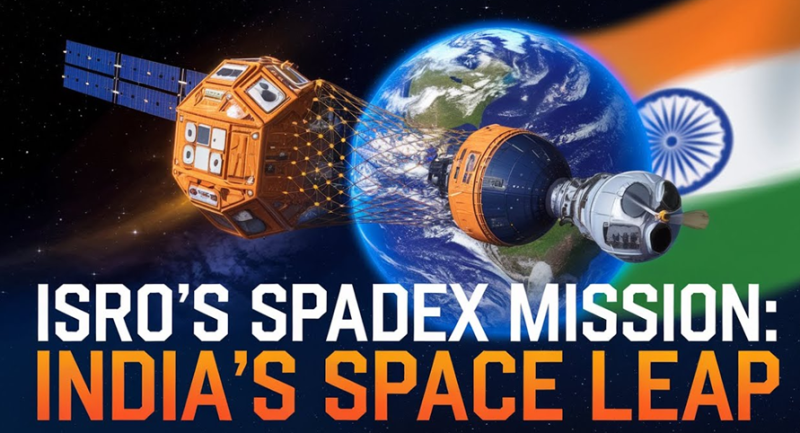
India made significant strides in strengthening national launch and space infrastructure during 2025, achieving multiple technological firsts, expanding launch capacity, deepening industry participation, and reinforcing international cooperation, the Government informed.
Key mission and launch achievements
SPADEX mission successfully demonstrated autonomous docking and undocking, power transfer between satellites, and circumnavigation, making India the fourth nation globally to demonstrate space docking—critical for future space stations and in-orbit servicing.
POEM-04, flown aboard PSLV-C60/SPADEX, completed 1,000+ orbits carrying payloads from ISRO, startups and academia, demonstrating robotic arm operations and seed germination in microgravity.
GSLV-F15/NVS-02 (Jan 2025) marked the 100th launch from Sriharikota with precise orbital injection.
GSLV-F16/NISAR became the first joint ISRO–NASA mission, launching the world’s first dual-frequency SAR satellite, now fully operational.
LVM3-M5/CMS-03 and LVM3-M6/BlueBird Block-2 missions set records for the heaviest GTO satellite and heaviest satellite launched from Indian soil, respectively, with payload capacity enhanced by 176 kg through design upgrades.
Launch infrastructure expansion
Government approval obtained for Third Launch Pad at Sriharikota to support Next Generation Launch Vehicles.
Construction commenced for a dedicated SSLV launch complex at Kulasekarapattinam, Tamil Nadu.
Manufacturing and propulsion capability enhancement
Commissioning of a 10-ton vertical solid propellant mixer at Sriharikota and a second Ammonium Perchlorate process line at Alwaye, Kerala.
Commissioning of a Cryogenic Turbopump Test Facility and a Titanium Alloy Tank Production Facility at Tumakuru, Karnataka.
Development and qualification of a 300 mN high-thrust electric propulsion system.
Successful demonstration of cryogenic engine restart capability, bootstrap start of gas-generator cryogenic engine, and Vikas engine throttling, supporting future reusable launch systems.
Indigenous electronics and processors
Development of VIKRAM3201, India’s first 32-bit indigenous processor qualified for space, in collaboration with SCL Chandigarh.
Induction of VIKRAM1601 (16-bit) processors across ISRO launch vehicles.
Development of KALPANA32, a SPARC-based processor, and indigenisation of onboard and payload controllers.
Industry participation and technology transfer
SSLV technology transferred to HAL.
Transfer of technologies including Lithium-ion batteries, Integrated Modular Avionics, sensors, and distress alert systems to private industry.
100 Technology Transfer Agreements signed through NewSpace India Limited, ISRO and IN-SPACe.
Industry participation in manufacturing 1 lakh two-way MSS terminals for fishermen and development of micro-Earth observation satellites.
International cooperation and disaster management
10 international cooperation agreements signed in 2025, including with NASA, ESA, Japan, South Africa, Australia, Italy, Sweden, Saudi Arabia, Philippines and Republic of Korea.
Installation of NavIC timing receiver at Italy’s INRIM.
Leadership roles held by Indian officials in UNCOPUOS working groups.
ISRO received 2,260+ satellite datasets and provided 725 IRS datasets for global disaster response.
ISRO successfully led the International Charter ‘Space and Major Disasters’ for six months in 2025, coordinating 39 disaster activations and expanding access for developing nations.