India’s newly concluded Free Trade Agreement (FTA) with the European Union marks not just a trade breakthrough, but a rare example of a large emerging economy expanding market access without conceding control over sensitive domestic sectors, analysts said on Tuesday.
While the agreement opens the doors for over 99 per cent of Indian exports to receive preferential access to the EU’s vast consumer market, India has simultaneously ring-fenced politically and economically critical sectors such as dairy, grains, and sensitive agricultural products, underscoring a calibrated and confidence-driven negotiation strategy.
India is the EU's 9th largest trading partner, accounting for 2.2% of the EU's total trade in goods in 2023. Trade in services between the EU and India reached €59.7 billion in 2023, up from €30.4 billion in 2020.
The EU–India Free Trade Agreement (FTA), alongside the Investment Protection Agreement (IPA) and Geographical Indications (GI) Agreement, is expected to generate a sustained expansion in India's exports to the European Union with India's overall exports to the EU are estimated to grow by 35–45% over a five-year period following implementation. Pharmaceuticals are expected to record 8–12% annual growth, along with Engineering goods which include electrical machinery and industrial equipment, could grow at 7–10% annually, with deeper integration into European supply chains. Auto components and emerging electric-vehicle components, a key industry in terms of employment generation in India, are projected to experience faster growth, in the range of 10–15% annually, and potentially higher for EV-linked products, given currently high EU tariffs and India's cost competitiveness.
Combination of tariff reduction, investment protection, and geographical indication recognition will reposition India as a value creator rather than competing only on volumes- Dr Ranjeet Mehta, CEO & Secretary General, PHDCCI.
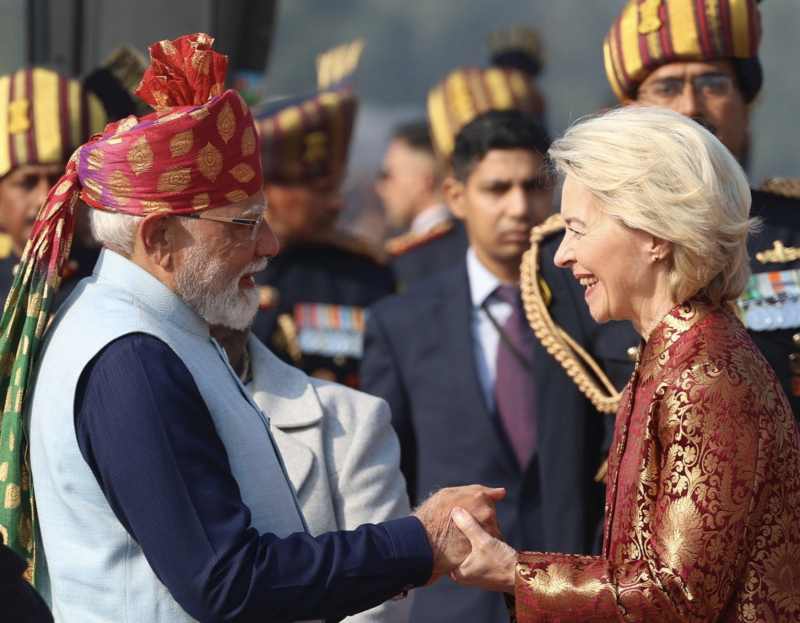
The deal—announced at the 16th India-EU Summit by Prime Minister Narendra Modi and European Commission President Ursula von der Leyen—links the world’s fourth-largest and second-largest economies, together accounting for 25 per cent of global GDP and nearly one-third of global trade.
From Market Access to Supply-Chain Influence
Unlike earlier FTAs that focused narrowly on tariff cuts, the India-EU agreement positions India as a key manufacturing and services node in European supply chains, particularly in textiles, engineering goods, automotive components, gems and jewellery, and processed food exports.
With tariffs on nearly $33 billion worth of labour-intensive exports set to fall—some by up to 10 per cent—the agreement is expected to shift sourcing decisions by European firms toward India, strengthening the country’s role as a China-plus-one alternative.
Services, Talent Mobility Set to Drive the Next Phase
A major differentiator of this FTA is its commercially meaningful services and mobility framework. Indian IT professionals, engineers, consultants, educators, and financial services experts will gain predictable short-term and professional access across 144 EU sub-sectors, significantly expanding India’s services export footprint.
Crucially, the agreement also lays the groundwork for future social security coordination, easing long-standing concerns of Indian professionals working in Europe.
CBAM: From Climate Risk to Negotiated Leverage
In a significant strategic win, India has ensured that the EU’s Carbon Border Adjustment Mechanism (CBAM)—often viewed as a trade barrier—will be addressed through technical cooperation, recognition of carbon pricing, and financial support mechanisms, rather than unilateral penalties.
This positions Indian exporters to adapt to global carbon norms without losing competitiveness, especially in steel, aluminium, and manufacturing exports.
A Template for Future Trade Diplomacy
Commerce and Industry Minister Piyush Goyal described the agreement as “a decisive shift from defensive trade policy to confident global engagement,” noting that India has balanced openness with national priorities.
With the EU becoming India’s 22nd FTA partner, the deal strengthens India’s broader trade architecture alongside agreements with the UK, EFTA, UAE, Australia, and Oman, effectively giving Indian exporters seamless access to the wider European market.