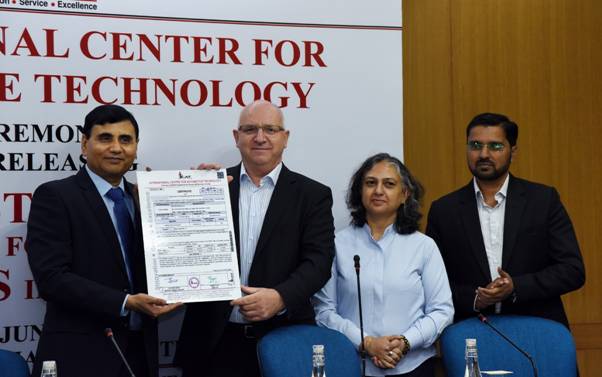
The International Centre for Automotive Technology (ICAT) today released India’s first Type Approval Certificate (TAC) for the two-wheeler segment under the Bharat Stage-VI (BS-VI) emission norms.
The certificate was formally released and handed over by Mr. Dinesh Tyagi, Director, ICAT, to senior officials of the concerned Original Equipment Manufacturers (OEMs).
Speaking on the occasion, Mr. Tyagi said that this marks a significant milestone for the Indian automotive industry, as it is the first BS-VI certification issued in the two-wheeler category. He noted that BS-VI represents the latest and most stringent emission norms, as notified by the Government of India. He added that ICAT has undertaken several initiatives to support the automotive industry in the development, optimisation, and calibration of engines and vehicles to ensure smooth compliance with the upcoming emission standards.
Bharat Stage (BS) norms are emission standards that automotive manufacturers must comply with to sell vehicles in India. These norms are applicable across two-wheelers, three-wheelers, four-wheelers, and construction equipment vehicles.
To address the growing challenge of vehicular air pollution, the Government of India decided to leapfrog directly from BS-IV to BS-VI norms, skipping the BS-V stage. The BS-VI norms came into effect from April 1, 2020, and from that date onwards, only vehicles compliant with BS-VI standards are permitted to be sold and registered in India. These norms are significantly more stringent and aligned with global emission standards.
ICAT had earlier issued the first BS-VI approval in India to M/s Volvo Eicher Commercial Vehicles for the heavy commercial vehicle segment, marking a similar milestone in that category.
The International Centre for Automotive Technology (ICAT) is a premier testing and certification agency authorised by the Ministry of Road Transport and Highways (MoRTH) to provide testing, validation, and certification services to vehicle and component manufacturers in India and abroad. ICAT is equipped with state-of-the-art facilities for emission testing, along with advanced infrastructure such as crash laboratories, NVH labs, EMC labs, and test tracks.