New Delhi | January 29, 2026
The Economic Survey 2025–26 has called for a deep reset in India’s policy mindset, arguing that an era of persistent global uncertainty demands a more entrepreneurial state—one that anticipates risks, experiments boldly, and moves decisively rather than reacting defensively.
Presented in Parliament by Union Finance and Corporate Affairs Minister Nirmala Sitharaman, the Survey’s Preface makes a compelling case for policy-making that prepares for uncertainty instead of avoiding it. It stresses the need to shift from risk aversion to risk preparedness, from rigid controls to capacity-building, and from compliance-heavy governance to trust-based systems.
In a striking metaphor, the Survey states that India must “run a marathon and a sprint at the same time—or run the marathon like a sprint”, underscoring the dual challenge of sustaining long-term growth while responding swiftly to short-term global shocks.
From Control to Empowerment
Rejecting the notion that such ambitions are abstract, the Survey points to early, tangible signs of change—mission-mode initiatives in semiconductors and green hydrogen, reforms in public procurement to support domestic innovation, and state-level regulatory agreements that replace inspection-led controls with trust-based compliance. These, it argues, offer a glimpse of what an entrepreneurial state looks like when capacity replaces mere compliance.
The Survey highlights India’s resilience in the post-Covid period, noting that despite repeated global disruptions, the economy has maintained strong macroeconomic fundamentals. It also flags the policy response following tariff actions by the United States in April 2025, arguing that the urgency of reforms has injected “new energy” into governance. India is now projected to grow at over 7% in real terms in 2025–26, with a similar trajectory expected next year.
Strong at Home, Uncertain Abroad
Yet, the Survey acknowledges a central paradox of 2025: India’s strongest macroeconomic performance in decades is colliding with a global system that no longer reliably rewards stability, capital discipline, or strategic restraint. Rising geopolitical tensions, fractured trade regimes, and reordering supply chains are reshaping the global economic landscape.
Against this backdrop, the Survey outlines three possible global scenarios for 2026:
A world of controlled disorder marked by lower coordination, higher risk aversion, and persistent uncertainty.
A more severe scenario of disordered multipolar fragmentation, with intensified strategic rivalry, sanctions, politicised trade, and financial stress spilling across borders.
A low-probability but high-impact systemic crisis where financial, technological, and geopolitical shocks amplify each other—potentially exceeding the severity of the 2008 global financial crisis.
In all three scenarios, India is seen as relatively better placed due to its large domestic market, strong foreign exchange reserves, lower financialisation, and credible strategic autonomy. However, the Survey cautions that these strengths do not guarantee immunity. Disruptions to capital flows and pressure on the rupee remain common risks across scenarios, differing only in scale and duration.
Strategy Over Panic
To navigate this environment, the Survey argues for strategic restraint rather than defensive pessimism. Economic policy, it says, must prioritise supply resilience, buffer creation, diversification of trade routes, and payment systems. India must simultaneously maximise domestic growth and enhance its ability to absorb shocks, with greater emphasis on liquidity, redundancy, and institutional resilience.
Policy Is Not Enough
Crucially, the Survey emphasises that India’s challenge is not only about better policies but better processes. Procedures define how citizens and businesses interact with the state, and their design can determine the success or failure of reforms. Encouragingly, recent deregulation and smart regulation initiatives—particularly at the state level—suggest that the system is capable of reinventing itself and moving decisively from control to empowerment.
The Survey brings together three pillars for achieving Viksit Bharat and greater global influence: state capacity, society, and regulatory easing. It reiterates that in a democracy, the state remains the central institution entrusted with development—and must therefore upgrade its skills, mindset, and strategic approach as old rules fade and new ones are yet to stabilise.
A Recast Economic Survey
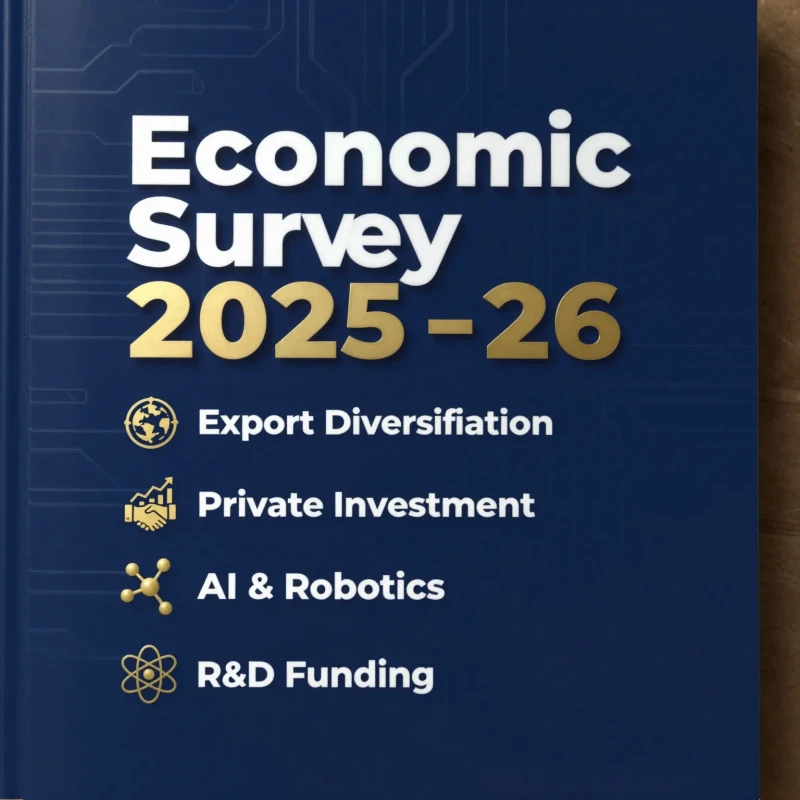
Reflecting its expanded ambition, the Economic Survey 2025–26 departs from its traditional format. The 17 chapters have been reorganised based on the depth and relevance of national priorities rather than a fixed hierarchy. The document is longer and broader in scope, concluding with three thematic essays of medium- to long-term importance: the development of artificial intelligence, the challenge of improving quality of life in Indian cities, and the role of state capacity and the private sector—including households—in achieving strategic resilience.
In essence, the Survey argues that amid global churn, India’s greatest opportunity lies not in chasing short-term relief but in building long-term resilience, fostering continuous innovation, and staying the course towards a developed India—even when the global rulebook itself is being rewritten.