

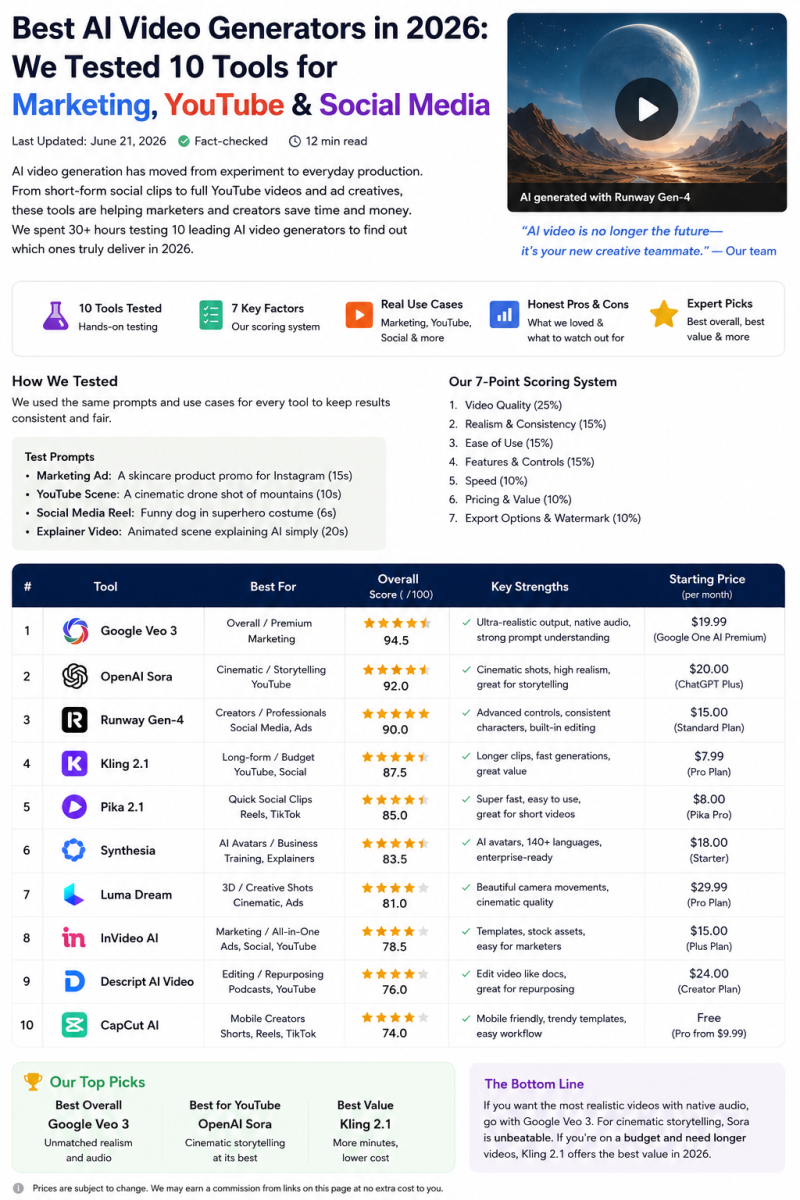
The AI video industry has entered a new phase. What began as short, experimental clips in 2024 has evolved into production-grade video generation capable of creating advertisements, social media content, training videos and cinematic sequences in minutes.
Recent advancements from Google's Veo platform, Runway's Gen-4 models and China's Kling AI have intensified competition in a market increasingly viewed as the next major battleground in generative AI. Industry analyses indicate that AI video quality, clip length and audio synchronization have improved dramatically over the past year, making the technology commercially viable for many use cases.
Why AI Video Is Suddenly Everywhere
The rise of short-form video across social media platforms has created unprecedented demand for content production.
Brands, creators and agencies are under pressure to produce more videos across YouTube Shorts, Instagram Reels, LinkedIn, TikTok and emerging AI-native channels.
Traditional video production often requires scripting, filming, editing and post-production. AI video tools promise to compress that workflow into a prompt-based process that can generate usable content within minutes. Industry observers describe 2026 as the year AI video crossed from experimentation into mainstream creator workflows.
The Major Players
Google Veo
Google's Veo has emerged as one of the most closely watched AI video models due to its integration with the broader Google ecosystem. Analysts point to realistic motion, native audio generation and compatibility with Google's creator tools as major advantages. Google has also expanded accessibility through lighter and lower-cost versions of the platform.
Runway
Runway remains popular among agencies and professional creators because it combines generation with editing capabilities. Rather than acting solely as a video generator, it functions more like a production suite, offering greater control over the creative process.
Kling AI
Kling has gained traction among social media creators because of its affordability and ability to produce longer clips. Several industry reviews rank it among the strongest value-for-money options currently available.
Synthesia
While cinematic AI video attracts headlines, enterprise adoption is increasingly centered around avatar-based video. Synthesia has become a preferred platform for training, onboarding and corporate communications, where realism is less important than speed and scalability.
-2026-in-australia_4.jpeg)