

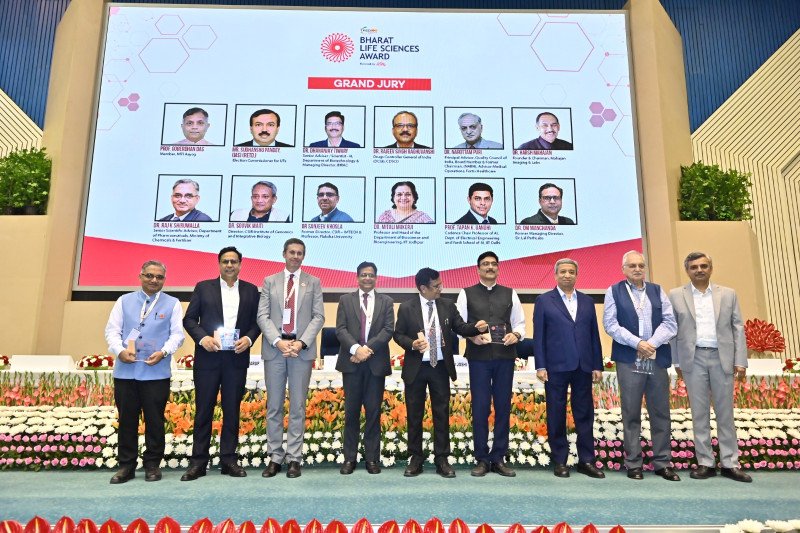
Union Minister of Health and Family Welfare and Chemicals and Fertilizers Shri Jagat Prakash Nadda has urged the country’s life sciences industry to make patient-centric innovation its central mission, as the inaugural Bharat Life Sciences Award (BLSA), organised by FICCI and powered by Eli Lilly and Company (India), named its first winners at Vigyan Bhawan on Thursday.
“True success is not just inventing in the lab, but taking discoveries from bench to bedside, ensuring high-quality care is accessible, timely and affordable for the last person in the queue,” Shri Nadda said in a video address.
Citing Ayushman Bharat PM-JAY’s ₹5 lakh annual cover, now extended to every citizen aged 70 and above, he said India’s bioeconomy, pharmaceutical manufacturing and vaccine leadership had shown “what India can deliver when scientific capability aligns with clear public purpose”. Flagship initiatives such as Biopharma Shakti, he added, were steering the sector in that direction.
The award, backed by ₹7 crore in grant support, drew more than 500 applications in its first edition. Winners were selected through an independent evaluation weighing scientific excellence, innovation, evidence, relevance to India and potential impact, with Grant Thornton Bharat as process advisor.
Samman (grants)
Ramanujan Arogya Udaan Samman (Young Scientist): Dr Vamsee Mallajosyula, National Centre for Biological Sciences (TIFR); runner-up Dr Bharti Bhatia, Translational Health Science and Technology Institute
Charaka Arogya Samman (Innovation for Unmet Patient Needs): Pacify Medical Technologies
Sushruta Arogya Samman (Translational and Clinical Advancement): Bharat Serums and Vaccines (BSV-Mankind)
Nalanda Arogya Vigyan Samman (Institute of Scientific Excellence): BRIC-National Institute of Biomedical Genomics; runner-up LV Prasad Eye Institute
Gaurav (recognition)
Jivaka Arogya Navpravartan Gaurav (Startup and Academic Innovator): Sciverse Solutions
Sarabhai Arogya Drishti Gaurav (Promoting Scientific Ecosystems): Dr Ratnesh Jain, Institute of Chemical Technology, Mumbai Biocluster
Prof Gobardhan Das, Member, NITI Aayog, said India needs a far deeper pipeline of new vaccines and medicines. Too much laboratory research, he said, never reaches production. “Academia and industry collaboration is absolutely necessary to take this further,” he said, urging the sector to harness India’s strength in artificial intelligence.
Earlier in the day, during the session on life science manufacturing, at the innovation summit, Shri Manoj Joshi, Secretary, Department of Pharmaceuticals, called the rise in biologics plants over the past two to three years, including for global contract manufacturing, “very encouraging”. He identified inputs as the most challenging gap, noting India’s near-total dependence on mostly European suppliers for media, resins, cell lines and enzymes. The Biopharma Shakti scheme, he said, would support companies on regulatory approvals abroad, manufacturing capacity and inputs. “In a few months’ time, we would be providing support to the entire value chain, and we would like industry also to move forward on that.”
During the session on vaccine and infectious disease platforms, Dr Rajeev Singh Raghuvanshi, Drugs Controller General of India, set out three expectations: innovation, collaboration and early dialogue with the regulator. “We have to move from being a manufacturing hub to an innovation hub,” he said, citing the heat-stable, nasal and mRNA vaccines developed during Covid-19. Engagement with the regulator, he added, should begin at the outset: “Regulatory strategy should be part of your core development strategy.”
“India has extraordinary scientific talent and an important role to play in advancing life sciences innovation,” said David A. Ricks, chair and CEO of Eli Lilly and Company. “The Bharat Life Sciences Award provides a meaningful platform to recognize that talent, strengthen collaboration across the scientific community, and help promising ideas move from discovery toward real-world impact. Lilly is proud to support this effort and the innovators working to improve health in India and around the world.”
Mr Pankaj Patel, Past President, FICCI, and Chairman, Zydus Lifesciences, noted that India carries 15% of the global disease burden yet hosts only 4% of clinical trials. “We are the world’s pharmacy by volume but still a small player in discovery,” he said. “Our ambition must move from pharmacy of the world to the lab of the world.”
He urged companies to raise R&D spending from about 5% to 8-10%, and called on the government to restore the 200% R&D tax deduction, with industry matching it “rupee for rupee”. He also called for predictable regulatory timelines, expedited pathways for breakthrough therapies and for the government to be “the first customer for innovations done in India”. India, he said, had already shown it could make medicines at scale: “The harder question now is, can India discover them?”
Welcoming guests, Mr Anant Swarup, Secretary General, FICCI, said the award recognised the people, institutions and ideas advancing life sciences in India. “As FICCI marks its centenary, we remain committed to creating platforms that encourage collaboration and strengthen India’s innovation ecosystem,” he said. “An award recognises an achievement, but its greater purpose is to inspire what comes next.”
The accompanying Innovation Summit drew more than 50 senior government officials, over 100 chief executives and some 1,200 delegates to sessions on manufacturing, AI-enabled drug discovery and vaccine platforms.
“Our collective responsibility is to ensure that progress in life sciences translates into better health, better access and better outcomes for our citizens,” Shri Nadda said.
.jpg)
