July 03, 2026
The Malaviya Mission Teacher Training Centre (MMTTC), Jamia Millia Islamia, New Delhi, successfully organized a Two-Week Online Multidisciplinary Refresher Course on Oriental Languages- “Reflection of India and its Culture in Arabic, Persian and Sanskrit Literatures” from 09 to 22 June 2026.
The Refresher Course was envisioned and conceptualized by the Hon’ble Vice Chancellor Prof. Mazhar Asif with an aim to foster a comprehensive understanding of India’s shared intellectual, literary, and cultural heritage as represented in the rich classical traditions of Arabic, Persian, and Sanskrit. Prof. Kulwinder Kaur, Director, MMTTC, JMI warmly welcomed and thanked the Hon’ble Vice Chancellor for this opportunity to bring out the glory of Indian’s rich history, culture, tradition and civilisational richness through this unique blend of three oriental languages.
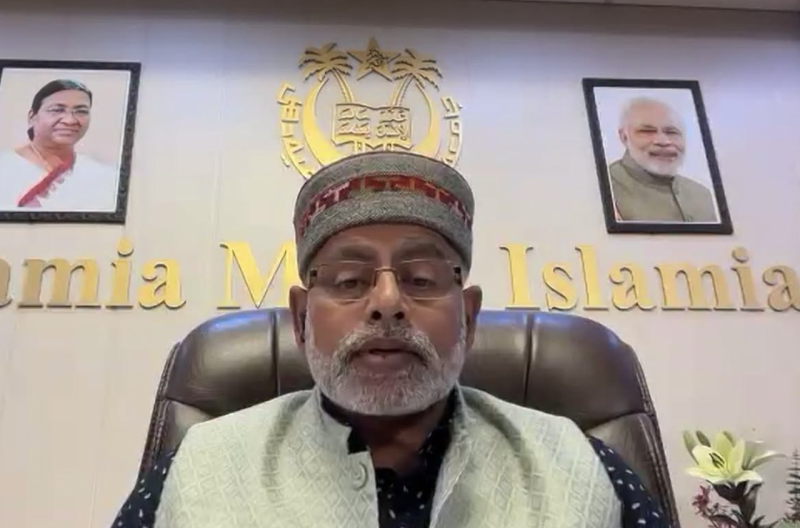
Inaugurating the programme, Prof. Mazhar Asif acknowledged the efforts of Prof. Kulwinder Kaur, Director of MMTTC and three Course Coordinators, Prof. Habibullah Khan, D/o Arabic; Prof. Syed Kaleem Asghar, Head, D/o Persian; and Prof. Jay Prakash Narayan, Head, D/o Sanskrit, for their successful planning, organisation and execution of this multidisciplinary course on such an important subject.
He underlined the importance of India as a civilization in the wider world. Being a literary scholar of many languages, it was a delight for the participants to listen to the rare narratives spanning the legacy of Sassanid ruler Khosrow Parviz, the Nishapur tradition and a royal physician’s search of the Aab-e-Hayat (the water of life) that led him to discover Panchatantra, a text that was subsequently translated into Pahlavi, Arabic, and later became one of the most influential works in the world literature.
Prof. Asif explained the way, Syed Sulaiman Nadvi, a scholar of the intellectual tradition of Takshila (Taxila), contributed to the cultural exchange between India, Iran, and the Arab world, enabling Indian thought to find its place within the literary canons of these civilisations. He underlined the contribution of the celebrated Persian poet of India, Amir Khusro, in immortalising every facet of the Indian landscape: be its air, water, flora, or beauty through his verses. The Vice Chancellor referred to many eminent literary figures such as Faizi, Dara Shikoh, Mirza Ghalib to bring out the exemplary synthesis between Indian and Arabic-Persian literary traditions. He concluded his address, by emphasising the unique role of teachers as bridges between languages, cultures, and hearts! He called upon the participating faculty to actively exchange their scholarly perspectives across linguistic boundaries to foster deeper mutual understanding.
Over the span of 12 days, the programme saw enthusiastic participation from 87 participants from16 states, and working in different central, state, deemed and private universities across the country. The programme also brought together a diversity of distinguished scholars, researchers, writers and faculty members as resource persons from all parts of India.