New Delhi: As countries worldwide compete for leadership in artificial intelligence, semiconductors, and advanced technologies, India is making a strategic investment in what many experts consider the most critical ingredient of technological competitiveness: human capital.
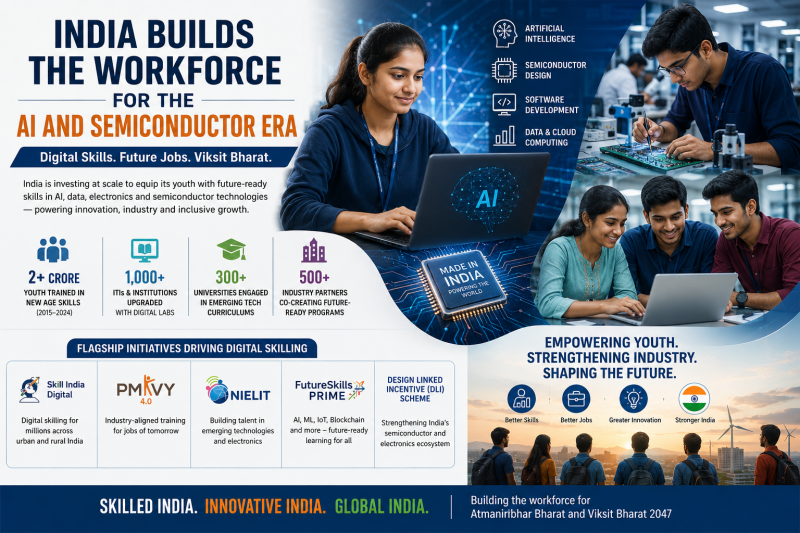
Through initiatives such as the Skill India Digital Hub (SIDH),AI-focused training programmes, and the Chips to Startup (C2S) initiative, India is building a future-ready workforce designed to support its ambitions in emerging technologies and advanced manufacturing.
The Skill India Digital Hub has emerged as a cornerstone of the country's skilling ecosystem. By March 2026, more than 15 million candidates had registered on the platform, which offers over 1,000 courses across 23 languages. The platform integrates skill development, employment opportunities, apprenticeships, and entrepreneurship support into a single digital ecosystem, enabling learners to access career pathways and lifelong learning opportunities regardless of geographic location.
Industry observers view the platform as a critical enabler of workforce transformation, particularly at a time when technological disruption is reshaping labour markets across sectors.
Artificial intelligence has become a major focus area within India's skilling strategy. Under the national AI training framework, thousands of learners have already completed certification programmes across different levels of AI literacy and expertise. By February 2026, more than 15,000 certificates had been issued under the "AI to Aware" programme, while additional certifications were awarded through "AI to Aspire," "AI to Acquire," and "AI for Educators" initiatives.
Developed in collaboration with industry leaders including Microsoft, NASSCOM, CII, and other partners, the programme now offers 50 AI and AI-application courses aimed at expanding access to cutting-edge digital skills.
Alongside AI, India is investing heavily in semiconductor talent development. Recognizing semiconductors as the foundation of modern electronics and digital infrastructure, the Ministry of Electronics and Information Technology launched the ₹250-crore Chips to Startup (C2S) programme in 2022.
The initiative seeks to create a talent pipeline of 85,000 industry-ready professionals across undergraduate, postgraduate, and doctoral levels over five years. The programme also supports startup incubation, intellectual property creation, technology transfer, and advanced research in chip design, Very Large Scale Integration (VLSI), application-specific integrated circuits (ASICs), system-on-chip (SoC) technologies, and embedded systems.
The programme has already demonstrated measurable outcomes. Nearly one lakh users across approximately 400 organisations—including academic institutions and startups—have accessed the National Electronic Design Automation infrastructure. More than 265 industry-led training programmes have strengthened chip-design capabilities, while the ChipIN Centre at the Semiconductor Laboratory in Mohali has facilitated multiple shared wafer runs supporting over 120 chip design submissions.
Participating institutions have filed more than 75 patents, while over 500 intellectual property cores, ASICs, and SoC designs are currently under development.
Technology analysts believe these investments represent more than workforce programmes; they form the foundation of India's broader ambition to become a global hub for innovation, semiconductor design, artificial intelligence, and advanced manufacturing.
As competition for technology talent intensifies worldwide, India's focus on research, education, innovation, and digital skills is creating a new generation of engineers, researchers, entrepreneurs, and innovators. In doing so, the country is not only preparing its workforce for future industries but also strengthening its position as a trusted global centre for knowledge, innovation, and technological leadership.