As Corporate India steps into 2026, workplace infrastructure is no longer defined by cubicles and rigid office hours. Offices across Gurugram's Cyber City, Bengaluru's Outer Ring Road, and Hyderabad's HITEC City are being reimagined as dynamic, human-centric environments that prioritise flexibility, sustainability, technology, and employee well-being. The same shift is playing out in hotel lobbies, business lounges, and extended-stay properties competing fiercely for the modern travelling professional. Here are five changes shaping that transformation right now.
1. Modular, experience-led workspaces are replacing fixed desks and blank hotel lobbies
The era of assigned seating is giving way to fluid, activity-based design and nowhere is this more visible than in the rapid expansion of operators like WeWork India, which has been aggressively scaling its presence across Gurugram, Mumbai, and Bengaluru with spaces that feel less like offices and more like curated environments. Collaboration zones, acoustic focus pods, and lounge-style breakout areas are now standard, not premium.
Complementing the spatial shift are the brands filling these spaces with personality. Nespresso's business solutions arm has become a fixture in corporate pantries and hotel executive floors alike — its machines now functioning as social anchors in breakout areas, as much about the ritual as the caffeine. Meanwhile, homegrown specialty coffee brand Blue Tokai is making inroads into premium co-working and boutique hotel spaces in Delhi NCR and Bengaluru, riding the wave of India's fast-maturing coffee culture.
2. Air quality and wellness infrastructure are getting boardroom attention
Indoor air quality, once the exclusive concern of facility managers, is now a C-suite talking point. Following a post-pandemic surge in awareness, companies like Honeywell have seen strong uptake of commercial air purification and HVAC upgrades across Indian corporate campuses and five-star hotel properties. Ergonomics, circadian lighting, and biophilic design — think living walls, natural materials, and daylight-optimised interiors — are also moving from amenity to baseline expectation, particularly in hospitality spaces where guest wellness has become a core brand differentiator.
3. Hydration infrastructure is being rethought as a wellness touchpoint
Alongside air quality, hydration is emerging as a measurable wellness metric inside offices and upscale hospitality spaces. The humble water dispenser is being replaced by purpose-engineered purification systems that blend into contemporary interiors rather than disrupting them.
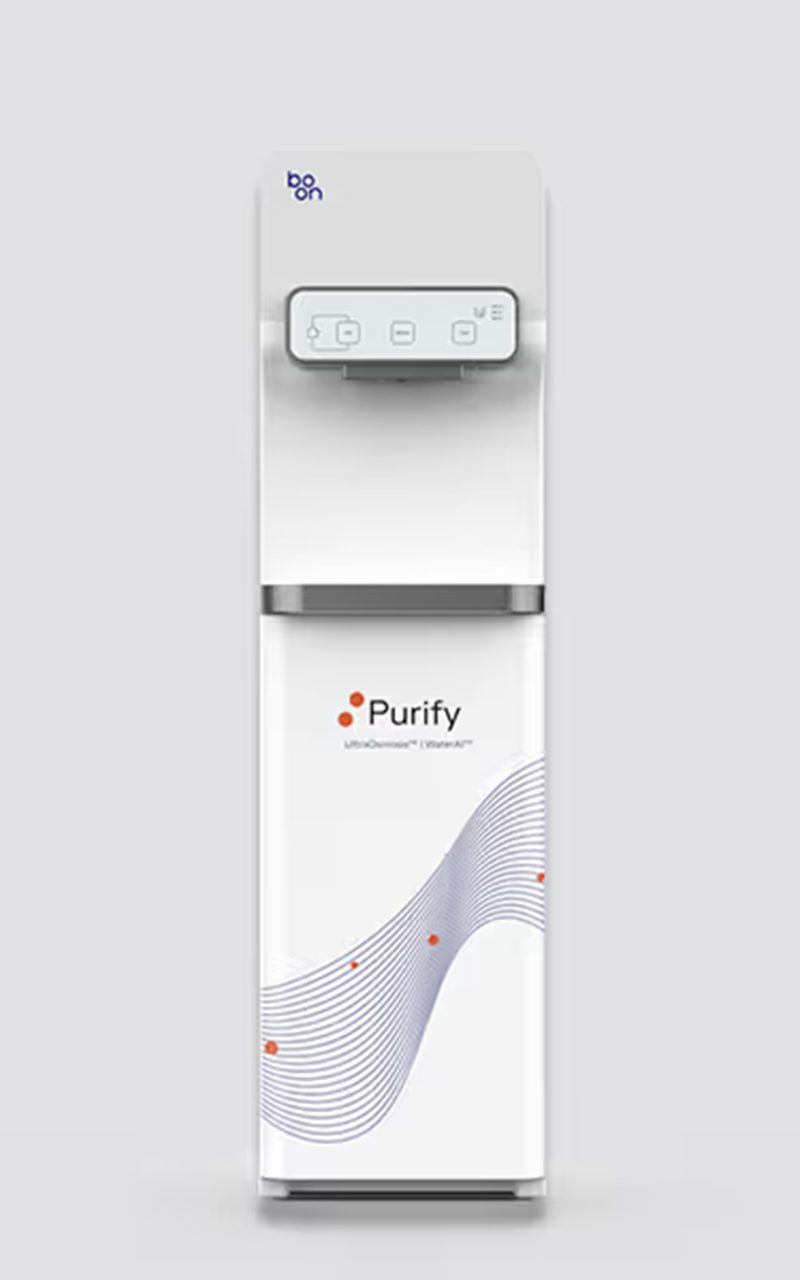
Gurugram-based Boon is making the most compelling case that water deserves the same design obsession as coffee or air quality. Trusted by the offices of Google, McKinsey, and BCG, and installed at ultra-luxury hospitality properties including Six Senses, Aman, and Oberoi, Boon's commercial systems — the Purify Pro and Purify Tall — are engineered at 5–10x the output of standard purifiers, with a 15.4" touchscreen interface and a form language built for spaces where aesthetics are non-negotiable. Purify Tall is priced at INR 45,000, while Purify Pro is available on request, with customers able to obtain a quote via the company's website. Behind the hardware is WaterAI™, Boon's proprietary IoT platform that monitors quality and predicts maintenance in real time across 400+ corporate and hospitality installations in 11 countries. Water, in Boon's framing, is no longer a utility. It is an amenity.
The shift reflects a broader trend across hospitality and corporate environments. As offices pursue WELL certification and hotels look to enhance their wellness positioning, every utility — including water — is being evaluated for quality, experience, and environmental impact.
4. The workplace and the hotel are converging into an experience destination
Perhaps the most significant shift is philosophical. Leading offices and hotels in India's major hubs are no longer offering space alone; they are curating experiences. Amenities once limited to multinational tech campuses — such as premium coffee bars, wellness rooms, and concierge-style services — are now common across commercial developments in Gurugram, Pune, and modern business hotels redefining the check-in experience.
Extended stay and co-working integrated formats have further blurred the lines between hotel and office, especially for travelling executives who expect consistent infrastructure wherever they work.