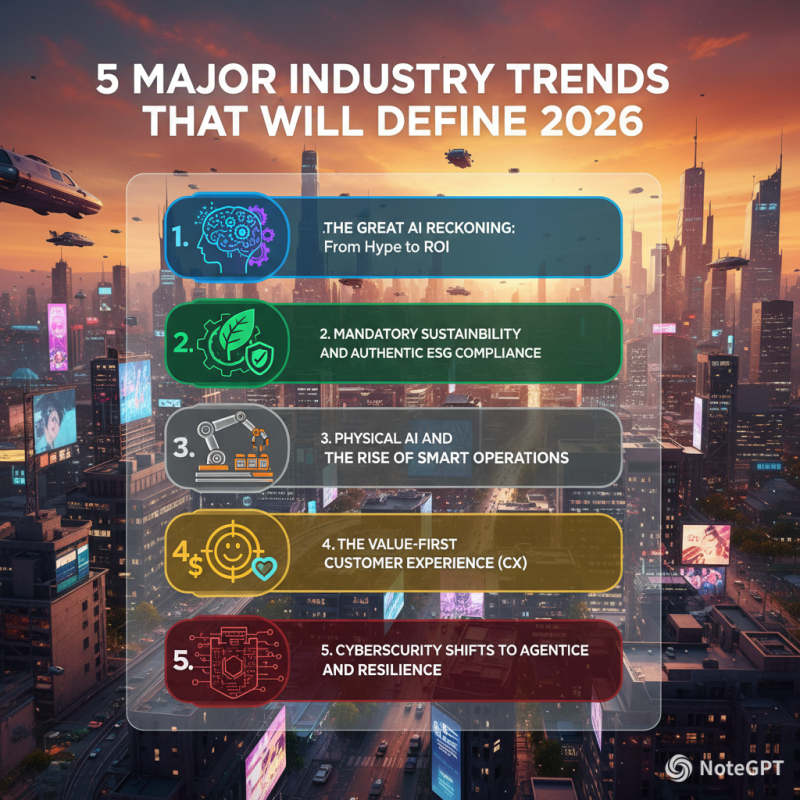
The year 2026 will mark a decisive shift from the experimental phase of new technologies and reactive market volatility to a period defined by pragmatic implementation and measurable value. Businesses will stop chasing every new headline and instead focus on integrating the most impactful, durable changes into their core operations.
Here are the 5 major industry trends set to define the next twelve months and beyond.
1. The Great AI Reckoning: From Hype to ROI
In 2026, Artificial Intelligence—specifically Generative AI (Gen AI)—will move from being a proof-of-concept curiosity to an embedded operational tool. The focus shifts entirely from "what AI can do" to "what AI is actually doing for the bottom line."
The Trend: Enterprises will demand clear, quantifiable Return on Investment (ROI) from their AI investments. This means prioritizing tangible use cases: automating specific, end-to-end workflows (Hyper-automation), enhancing customer service through autonomous agents, and generating code.
The Impact: Leaders will invest heavily in foundational AI infrastructure—including data governance, high-performance computing (Cloud 3.0), and robust security protocols—to ensure these tools operate reliably at scale. Companies that successfully redesign broken processes before automating them with AI will see massive productivity gains, while those that simply automate dysfunction will face significant, costly failures.
The Action: Focus on Human-AI Chemistry, redefining roles to leverage human expertise in supervision, governance, and creative direction, allowing AI to handle execution.
2. Mandatory Sustainability and Authentic ESG Compliance
Environmental, Social, and Governance (ESG) initiatives will transition from voluntary corporate social responsibility (CSR) to being highly regulated, technology-driven mandates. Climate action and sustainability will become non-negotiable costs of doing business.
The Trend: The increasing implementation of global regulations (like the EU's CSRD) will require tens of thousands of companies to integrate verifiable sustainability data and climate disclosures into their financial reporting. There will be a massive technological push to eliminate greenwashing (superficial eco-friendly marketing).
The Impact: Every business will need AI-powered analytics to track supply chain emissions, energy consumption, and compliance in real time. This drives growth in clean energy investments and necessitates a shift toward circular economy models (where waste is minimized and resources are reused).
The Action: Companies must invest in supply chain transparency tools and integrate ESG data tracking directly into their financial and operational systems to prove genuine sustainability efforts to regulators and customers.
3. Physical AI and the Rise of Smart Operations
AI intelligence is no longer confined to the screen; it is moving into the physical world, driving a new wave of efficiency across manufacturing, logistics, and infrastructure. This is the era of Physical AI and Smart Factories.
The Trend: The integration of AI with Advanced Robotics, the Industrial Internet of Things (IIoT), and digital twin technology will create genuinely autonomous operations. Robots with advanced autonomy (Physical AI) will navigate unstructured environments, while IIoT sensors provide constant, real-time operational data.
The Impact: Manufacturing and logistics will see unprecedented efficiency, lower downtime (due to Predictive Maintenance), and increased precision. Digital Twins—virtual replicas of physical assets—will allow companies to simulate changes, test new layouts, and optimize processes without disrupting real-world operations.
The Action: Organizations must invest in retrofitting legacy equipment with IIoT sensors and adopt AI-driven maintenance platforms to shift from reactive repairs to proactive optimization.
4. The Value-First Customer Experience (CX)
After years of fragmented, surface-level personalization, consumers and B2B buyers alike are experiencing CX fatigue. In 2026, the market will reward companies that deliver genuine, consistent value and transparency over simple digital flashy tactics.
The Trend: Buyers—both consumers and businesses—are more empowered and wary. They will reject experiences that feel invasive, non-transparent, or simply fragmented across channels. Trust becomes the single greatest differentiator.
The Impact: B2C leaders will see a greater decline in engagement from traditional display advertising, pushing budgets toward platforms and channels that provide clear, tangible utility. Marketing will pivot to delivering value through content, education, and highly relevant, contextual personalization, not just tracking.
The Action: Audit customer journeys for "fragmentation points." Companies need to invest in unified data platforms to ensure a single, holistic customer view that drives real-time, relevant service and sales interactions.
5. Cybersecurity Shifts to Agentic Defense and Resilience
As cybercriminals utilize AI to generate more sophisticated attacks (Gen AI phishing, polymorphic malware), the defense strategy must evolve from reactive human monitoring to proactive, intelligent systems.
The Trend: Cybersecurity will pivot to Agentic Defense, where autonomous AI agents monitor the network, analyze anomalies, and execute defensive countermeasures—such as isolating an infected host—faster than any human team could react.
The Impact: Geopolitical instability and the rapid evolution of technology require companies to prioritize cyber resilience over mere prevention. The focus moves to the ability to quickly recover, adapt, and operate even after a successful breach. New risks associated with the governance of Gen AI (hallucinations, bias) become major compliance concerns.
The Action: Implement AI-driven security operations (SecOps) tools and conduct frequent, advanced stress tests (like "Red Team" exercises) that specifically target vulnerabilities introduced by new AI technologies and hybrid work setups.
These five trends—pragmatic AI, mandatory sustainability, physical automation, trust-driven CX, and agentic security—will compel leaders across all sectors to rethink their strategies, demanding greater clarity, resilience, and value delivery in the year ahead.