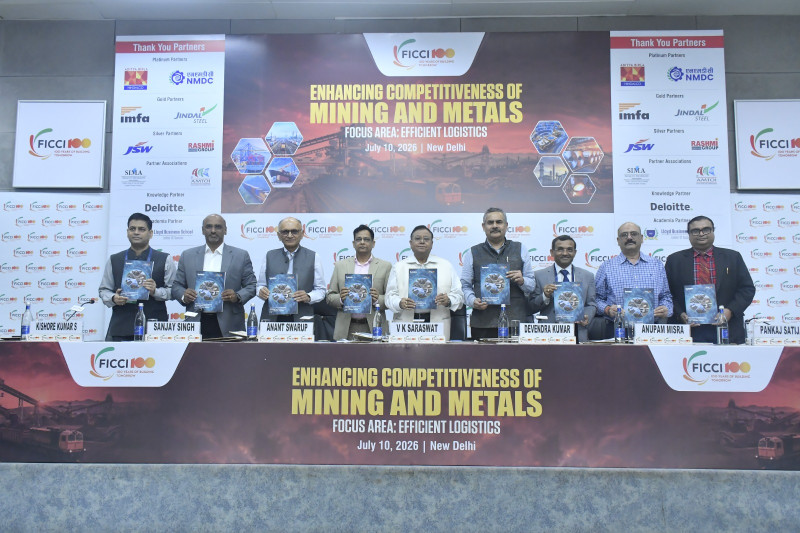
NEW DELHI, 10 July 2026: India's logistics cost for the mining and metals sector may be far closer to 8 per cent of GDP than the widely cited 14 per cent figure, though the sector’s underlying bottlenecks remain unchanged, Dr V K Saraswat, former member of NITI Aayog, said at the FICCI conference on Enhancing Competitiveness of Mining and Metals.
Dr Saraswat, however, cited that bulk freight bottlenecks, mining-specific evacuation gaps are still real and costly. He identified two structural weaknesses continuing to hold back the sector — inadequate first- and last-mile connectivity from mines situated in remote, forested or mountainous terrain, and continued over-dependence on road haulage, which he said could cost two to three times more per tonne-kilometre than rail for bulk commodities. He set out a ten-point national strategy, including dedicated mineral freight corridors with end-to-end connectivity, wider use of conveyor systems and slurry pipelines, accelerated port mechanisation, rationalised logistics taxation, regional mineral logistics parks, expanded rail links to mining clusters and stronger digitalization across the value chain.
He further highlighted six emerging technologies poised to revolutionise operational efficiency — autonomous haul trucks and driverless trains, AI-based dispatch optimisation, drone-assisted surveying, robotics in material handling, digital twins for logistics networks for real-time simulation & decision-making, and satellite fleet monitoring integrated with 5G communications as the connectivity backbone for remote mining operations. He asserted that logistics must be recognised as a strategic determinant for mining & metals competitiveness.
Mr Devendra Kumar, Additional Member–Traffic at the Railway Board, set out the ministry's end-to-end logistics push, disclosing that Container Corporation of India already operated end-to-end container services between Delhi and Kolkata via Agra and Kanpur, as well as parcel trains between Mumbai and Kolkata. He said that the railways had trials with clubbing two or three freight trains and soon two-kilometre-long trains already run elsewhere could run in India.
He further advocated that government policies and industry initiatives must be fundamentally citizen-centric in their design and delivery — measuring success not by infrastructure created or schemes launched, but by the tangible improvement in the quality of life and economic opportunity they generated.